


Research the claims your book needs to make. Turn them into questions, locate suitable sources, and record enough citation detail to recover the evidence. Separate exact quotations from paraphrase and your interpretation, and keep disagreement or uncertainty visible. Draft alongside research so missing explanations become specific tasks. Use a stopping rule for each question, then verify claims against the sources again before treating a passage as finished.
Useful when nonfiction research keeps expanding while sources, quotations, and unresolved claims become hard to connect to the draft.Research can produce a strange kind of uncertainty: the fuller your folder becomes, the harder it is to say what you actually know. You remember an important date, but not where you found it. Three articles repeat a claim that seems to originate from one interview. An interesting side question has displaced the chapter you meant to write.
A workable system connects evidence to the questions your book must answer. This guide follows an invented local-history project about a neighborhood cinema and its changing role. The cinema, documents, and quotations below are illustrative. Use the process to organize your own material without treating the example as a report about a real place.
Turn the book’s promise into research questions
Begin with the chapter you need to develop, rather than with the largest possible subject search. “Research cinemas” opens an endless field. “What changed when this cinema moved from evening screenings to a mixed community programme?” identifies a comparison you can investigate. Break it into questions about dates, decisions, participants, and competing explanations.
Separate questions you need to answer from questions that merely interest you. The chapter may need the dates of a renovation, evidence about who used the building, and accounts of why the programme changed. It may not need the entire history of projection equipment. Keep a parking list so that setting aside a question does not feel like losing it.
Write what kind of material could answer each question. A dated programme can establish an advertised screening. It cannot by itself establish attendance or explain what the event meant to residents. Naming the evidence need in advance helps you avoid accepting a source simply because it is accessible and interesting.
Use orientation reading to build a search map
Start with reliable overviews to learn the vocabulary, chronology, and existing disputes around your subject. A local history, an archive catalogue, and a scholarly account may use different names for the same building or period. Record those variants. They can lead to material a search using only the present name would miss.
Make a compact search map with names, dates, organizations, places, and terms. For the cinema chapter, possible branches include the building’s former name, its operating association, a renovation committee, and the neighborhood newspaper. Follow references in useful sources rather than repeatedly starting from a blank search box. A librarian or archivist may help identify collections you would not otherwise know to search.
Treat this stage as orientation rather than proof. An overview may summarize a complicated episode in one sentence. Mark claims you want to trace and note where the author obtained them. When several summaries use similar language, investigate whether they rely on the same underlying account before treating them as independent confirmation.
A cinema programme and committee record.
The programme expanded beyond screenings.
A claim to be the area’s most popular venue.
Keep a source ledger that survives drafting
Give each source a stable identifier and enough information to find it again. For a book, record author, title, edition, publication details, and the exact pages used. For a web source, keep the page title, organization or author, URL, date when available, and your access date. For archival material, preserve collection and item references supplied by the repository.
Add a short description of relevance and limitations. “Programme, autumn season; lists advertised events, does not establish turnout” is much more useful than “good source.” Record whether you have viewed the original, a scan, a transcript, or another author’s quotation. Those distinctions matter when you later check wording, context, or a difficult date.
You can keep the ledger in an ordinary document or spreadsheet. Choose a tool you will maintain consistently. A complicated catalogue with missing entries is less useful than a plain table completed as you work. Back up your notes and permitted files, while respecting archive conditions and any restrictions attached to private or sensitive material.

Record the material you actually examined, its recoverable location and what it cannot establish.
Original editorial illustrationSeparate quotation, observation, and interpretation
When taking notes, label exact quotations unmistakably and include their location immediately. Put your own summary in a separate field, then record your interpretation in another. The separation helps prevent a source’s phrasing from drifting into your manuscript as though you composed it, and makes it easier to see when your conclusion exceeds the source.
Imagine a committee minute that says a proposal was deferred. Your observation is that the recorded decision was a postponement. Your interpretation might be that the group had not reached agreement. Those are different statements. The minute may not explain whether disagreement, missing information, or an absent member caused the delay. Write that uncertainty beside the note.
For visual material, describe what you can actually see before assigning meaning. A photograph of a queue shows a queue at a particular recorded moment; it does not prove the cinema was always crowded. The Library of Congress offers educational tools for observing and questioning primary sources. Apply that spirit of inquiry while keeping your own research notes specific to the item.
Keep the source’s limits beside the claim.
A fictional interviewee says a reading group “changed the whole town.” That sentence tells you how one participant describes the experience. It does not establish a town-wide effect.
An evidence boundary
- Recoverable material
Interview recording and location of the statement.
- Supports
One participant reports a strong personal impression.
- Still unestablished
How other residents experienced the group.
Record the wording and your interpretation separately, with the location needed to recover the passage. Decide what the chapter needs: an attributed account may be appropriate, while a broader claim requires a different basis. You can draft around the narrower statement and leave a visible research question. Do not strengthen it merely because several secondary pages repeat the same quotation; first check whether they depend on the same underlying source.
What if my sources disagree?
Record what each source actually addresses, including date, context and definitions. The disagreement may concern different questions rather than incompatible answers. Keep the uncertainty visible until you can explain it, and narrow the passage if the available evidence cannot resolve the point.
Evaluate sources in relation to the claim
Ask who created the material, for whom, when, and for what purpose. A cinema’s anniversary brochure may offer valuable names and dates while presenting the organization in a favorable light. A disappointed visitor’s letter may reveal a particular experience without representing all visitors. A source can be useful and limited at the same time.
Cornell’s source-evaluation guidance emphasizes considering evidence and relevance to your purpose. In practice, match your confidence to the source’s actual reach. If you want to claim a programme changed, compare programmes. If you want to explain why, look for decision records and informed accounts. If you want to describe how residents experienced the change, seek a range of relevant perspectives.
Keep an eye on missing people. An official archive may preserve committee voices more fully than those of casual visitors or staff. This does not let you invent the absent perspective. It gives you a reporting question and, where the gap remains, a limitation to acknowledge. More documents from the same organization will not necessarily solve that imbalance.
Prepare interviews around episodes, not conclusions
Before an interview, explain the project, the proposed recording, and how you expect to use the material. Clarify any review arrangements, attribution, and restrictions rather than making promises you cannot keep. The Oral History Association’s best-practice guidance is a useful starting point for oral-history projects; the appropriate process depends on the project and the people involved.
Build questions that invite specific recollection: “Can you walk me through the meeting where the afternoon programme was discussed?” is more open than “Why did the committee ignore older visitors?” Follow with questions about what the person saw, heard, did, and understood at the time. Leave room for them to challenge your premise or identify something your preparation missed.
Afterward, preserve the recording and notes securely under the agreed conditions. Mark time references for material you might use, verify quotations against the recording, and follow up on factual details that need corroboration. A vivid memory is valuable evidence of a person’s recollection. It does not automatically resolve every conflict about dates, motives, or what someone else thought.
Make disagreement visible instead of smoothing it away
Create a discrepancy note whenever sources conflict. Suppose the anniversary brochure dates the cinema’s reopening to June, a programme lists screenings in May, and an interviewee recalls an opening celebration in July. Resist picking the date that makes the cleanest paragraph. Define what each source is actually dating: first screening, formal reopening, or celebration.
Then investigate the difference. Look for contemporary notices, meeting records, and the documents surrounding the item you already have. Sometimes the contradiction dissolves when you distinguish events. Sometimes it remains unresolved. Your writing can say exactly what the records establish and where accounts differ, without pretending that uncertainty makes the whole chapter unusable.
This is also where a claim ledger helps. For every consequential assertion, list the supporting source, the relevant passage or location, contradictory material, and the degree of confidence warranted. You do not need a ledger entry for every ordinary connective sentence. Focus on facts, interpretations, quotations, and generalizations whose failure would change the reader’s understanding.
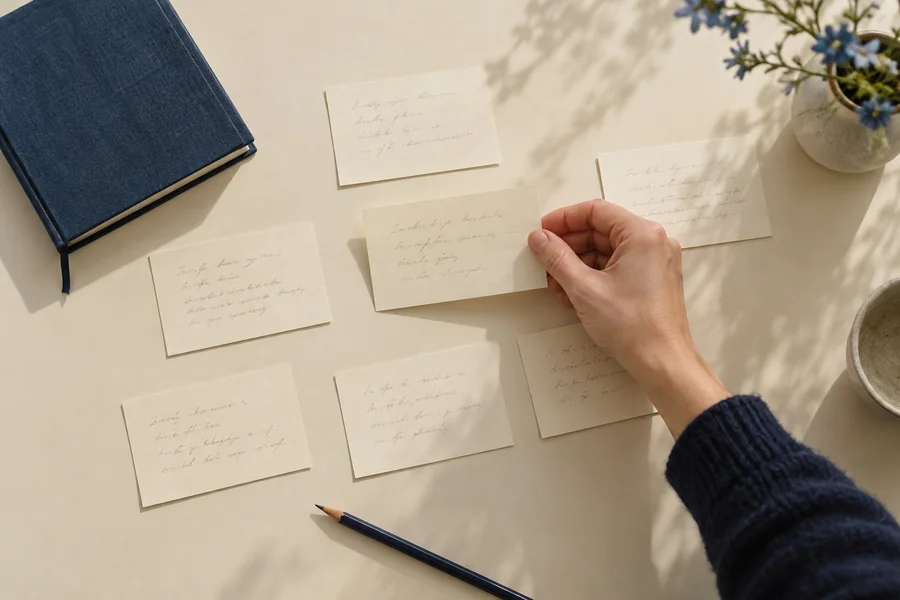
Treat the plan as a working arrangement. Let a passage test it before giving every chapter a permanent place.
Original illustrative photograph, created for BookDraftLab.Write alongside research to expose the real gaps
Draft short explanations while the research is still developing. Trying to explain the cinema’s changing programme may reveal that you know the dates but not who made the decisions. Another passage may show that your central question depends on an assumption about the building’s audience. These are useful discoveries that a growing reading list can conceal.
Use precise placeholders: “[CHECK: was this a committee recommendation or a final decision?]” tells you what to do next. “[RESEARCH]” does not. Keep placeholders distinguishable from finished prose, and maintain a list so none survive unnoticed into a public version. If a missing fact controls the chapter’s main argument, resolve it before building more reasoning on top of it.
Do not make research volume your measure of readiness. Ten additional articles may offer less value than locating one original document or asking a clear follow-up question. At the end of a research session, write what the material changes in the manuscript. If it changes nothing, identify whether it provides necessary context, closes a gap, or belongs outside the book.
Use a stopping rule and a final verification pass
A research stopping rule should depend on the project’s questions. You may be ready to draft a chapter when its essential factual spine is supported, major competing explanations have been considered, and remaining gaps are specific enough to track. This is a working threshold, not permission to leave important claims unchecked.
Before finishing the manuscript, return to the source trail. Check quotations, dates, names, numbers, and attributions against the actual materials. Confirm that a source supports the sentence it is attached to, rather than merely discussing the same subject. Review restrictions and any use or permission questions that remain. Citation alone does not settle every question about reproducing material.
Avoid endless browsing by assigning each unresolved question an action: verify, qualify, remove, or explain the uncertainty. For the cinema chapter, an unverified attendance estimate may be unnecessary if the argument concerns a documented change in programming. Removing a weak number can make the account clearer and more honest than spending days defending a detail the chapter never needed.
The reopened cinema immediately became the neighborhood’s most popular gathering place.
The May programme advertised afternoon talks alongside screenings. A committee record from the following month describes requests for more daytime events. These records show a broader programme; they do not establish how popular the cinema was across the neighborhood.
The revision identifies what the imagined documents could support and removes a ranking that would require different evidence.
Keep the claim within the evidence’s reach.
BOOKDRAFTLAB / ORIGINAL TEACHING MATERIALThe cinema’s advertised programme widened during the spring. The May programme lists afternoon talks alongside screenings; the following month’s committee record notes requests for more daytime events.
Those documents show what was advertised and what the committee recorded. They do not tell us how attendance compared with other neighborhood venues, or whether people who stayed away felt included. Calling the reopened cinema the area’s most popular gathering place would require evidence these records do not provide.
An original illustrative specimen. Adapt the method to your own material.
Build a research trail for one paragraph
- Choose a paragraph you want to write and list its three most consequential factual or interpretive claims. Turn any vague claim into a question you can investigate.
- Locate a relevant source for each question. Record its stable identifier, full location details, purpose, and limitations. Distinguish an original source from a later summary.
- For one source, save separate notes for an exact quotation, your own summary, and your interpretation. Add a discrepancy or missing-perspective note if needed.
- Draft the paragraph using only what the evidence supports. Mark specific unresolved questions and decide whether to verify, qualify, remove, or state the uncertainty.
A draft paragraph, three source-ledger entries, and a short claim checklist another reader could use to follow your evidence trail.
Could another reader recover the source behind each claim in your paragraph, distinguish quotation from interpretation, and see which uncertainty still requires a research action?
Make your own version here.
Common questions
How much research should I finish before drafting?
Enough to understand the topic’s basic context and support the chapter’s essential direction. Then alternate research with drafting. If a missing fact determines the whole argument, investigate it first. If it concerns a minor detail, use a precise placeholder and keep the gap visible.
Are primary sources always more reliable?
No. They offer a direct relationship to the material or period being investigated, but still have purposes, limits, and perspectives. Secondary scholarship can supply context and analysis you need to interpret them. Evaluate what each source can support rather than assigning automatic trust by category.
Can I use an interviewee’s memory when records disagree?
You can describe the recollection with appropriate attribution and context, while investigating the discrepancy. Do not silently convert a remembered detail into an established fact. Depending on its importance, explain the disagreement, qualify the claim, or omit a detail you cannot responsibly support.
Sources and further reading
- Library of Congress: working with primary sources
- Cornell: evaluating sources
- Oral History Association: best practices
These sources support further investigation. Check requirements at the relevant publisher or platform before a submission.