


AI Brainstorming for Writers: A Workshop
Prepare a short brief, evaluate three alternatives, and write your chosen premise plus a test passage and use record.
Read the guide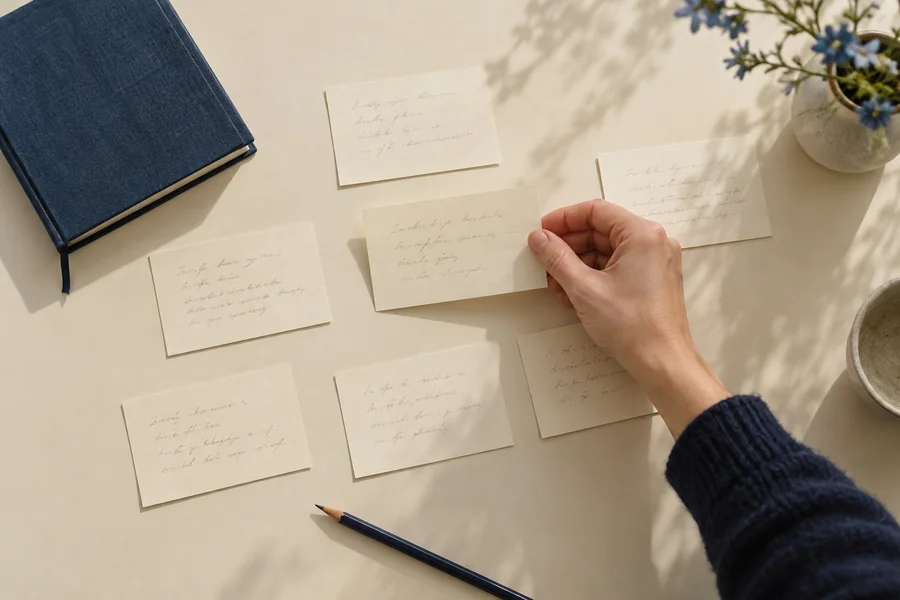
AI can produce options, questions, and draft material. The useful question is which bounded task you want help with and how you will evaluate the result. Asking for three possible obstacles is different from asking a system to decide the story. Asking where an excerpt becomes confusing is different from accepting every suggested rewrite. Keep enough of your own intention visible to make that distinction.
These guides focus on brainstorming, feedback, and recording how assistance was used. They are practical writing workflows, not legal conclusions or guarantees about a model’s output. Services handle submitted content under their own current policies. Publishers, competitions, and platforms can set different requirements. Review the actual destination before sharing or submitting work, rather than assuming a general label such as “AI assisted” resolves every question.
Find the right lessonAI is optional. Begin with the task you want help thinking about, the material you are comfortable supplying and the judgment you will retain.
Set boundaries, compare possibilities and write a test yourself.
YOU’LL MAKE A recorded idea decisionAsk one question and check every observation against the text.
YOU’LL MAKE A checked feedback ledgerAudit retained components and check the destination’s current rules.
YOU’LL MAKE A factual use recordThese lessons teach evaluation and record-keeping. The local BookDraftLab tools organize your own notes and do not generate AI text or send a manuscript to an external service.
Rewrite my chapter and make it better.
Identify two places where the character’s immediate goal is unclear. Quote the relevant sentence, distinguish observation from inference and ask a question. Do not rewrite.
A bounded request makes a suggestion easier to inspect. It cannot make generated claims, citations or judgments reliable by itself.
Your turn: Save the original, choose one suggestion to investigate and record what you actually keep.

Test alternatives against the same intention. Keep responsibility for the choice.
Original editorial illustrationAn original illustrative specimen. Adapt the method to your own material.
Prepare a short brief, evaluate three alternatives, and write your chosen premise plus a test passage and use record.
Read the guideAssemble a component inventory, factual use log, dated destination-policy note, and submission account checked against the actual files.
Read the guideCreate a focused request and checked feedback ledger, then compare one revised passage with the saved original.
Read the guide
Locate the passage, separate the reaction from a diagnosis and choose one change worth testing.
Original illustrative photograph, created for BookDraftLab.Supply the context required for the task, identify what must stay unchanged, and ask for a limited number of alternatives. Inspect the reasoning against the actual excerpt or project brief. A model may invent a quotation, misread a narrator, or propose a fact that needs research. Preserve the original and test a change in context. The goal is a decision you understand, not a manuscript made uniform by accepting every confident suggestion.
BookDraftLab’s tools run in your browser and do not perform AI generation. Fyrlo is an optional separate app for AI-supported story work, with its own service and privacy policies. A note saved here is not automatically copied into the app. Keep unpublished or sensitive material out of any service until you have checked whether its handling suits the project. Record meaningful uses as you go so a later disclosure question does not depend on reconstructing months of decisions.
Before sending a prompt, describe how you will recognize a helpful response. If you want to test clarity, ask the tool to point to the exact wording that made an interpretation possible. If you want alternatives, say how many and which constraints they must respect. An answer that sounds polished but does not address the task is not a reason to rewrite the whole excerpt. Compare the response with the question you actually asked.
Keep the evaluation separate from another round of generation. A system can produce an explanation for a weak suggestion as fluently as for a strong one. Return to the source passage, the project brief, or an appropriate external source when a factual claim matters. For submission questions, read the destination’s current policy directly.
A useful workflow gives you a record of the task, the material supplied, what was accepted or rejected, and what was checked. That record supports your own decision-making; it does not certify a work’s legal status or make different organizations’ requirements identical.