


Keep a factual record of what assistance you used and which generated material, if any, entered the work. Inventory components separately, including text, images, and translations, and connect entries to saved versions. Before submitting, check the current requirements of the intended destination and audit the actual files against the log. Use that evidence to answer the relevant questions; a platform's terminology or form does not automatically settle a different publisher's requirements.
Useful when preparing a manuscript or edition for submission and needing an accurate account of optional AI use.A question about AI use becomes harder when the book is finished and you cannot remember where particular wording or images came from. Keep a simple record while working. Note what the tool did, what you accepted and what you checked. This is useful even when you have not chosen a publisher, because different destinations may ask different questions later.
This guide was checked against public primary sources on 26 October 2026. It describes a recordkeeping and policy-checking process, not a legal conclusion about your manuscript. Our hypothetical writer, Nora, is making a short book of observations about seasonal color in her city. She uses an AI tool for planning questions, a grammar check and one proposed cover illustration. We will keep those uses distinct rather than assigning a single vague label to the entire project.
Separate the work you did from the label you might need
Begin with events, not a preferred category. Nora wrote her observation chapters herself, asked for possible organizational questions, accepted several grammar corrections and downloaded a generated illustration to consider for the cover. That account is more useful than writing AI helped a little. It can later be compared with a destination's definitions without relying on a label chosen from memory.
Keep distinct records for text, images and translations. A book can contain human-written chapters and a generated cover image. It can also contain a human-created illustration that a tool helped edit. The contribution may differ across components, and a policy may ask about those components separately. A general statement about the writing alone can omit a relevant part of the finished book.
Do not assume that a small contribution is automatically irrelevant everywhere. Record it accurately, then read the actual threshold or question you need to answer. Keeping a record does not determine the outcome; it preserves the information required to investigate the outcome honestly.
Understand the KDP distinction in its own context
KDP's Content Guidelines, checked on 26 October 2026, require publishers to inform KDP about AI-generated text, images or translations for new books and relevant republication. Its definition includes content created by an AI tool even when substantially edited afterward. It distinguishes assistance where the person creates the content and uses AI for improvement, or brainstorms with AI but creates the actual content personally. KDP does not require reporting that assisted category under this guidance.
For Nora, a generated cover candidate and a grammar-reviewed human paragraph therefore need separate attention if they enter a KDP edition. The fact that she redraws or edits a candidate is not a reason to skip reading the current generated-content definition. Record the origin and changes, then answer the actual submission questions using the current guidance.
This is a platform-specific distinction. It does not answer what Nora's readers, another publisher, a competition or a copyright application may require. It also does not establish that any particular material is lawful, original or suitable for publication. Keep the reporting question separate from those other responsibilities.
Which service made which material?
Which output remains in the actual files?
Which current rule applies to this submission?
Keep copyright registration separate from platform reporting
The US Copyright Office's registration guidance is dated 16 March 2023. Its Part 2 report on copyrightability was published on 29 January 2025. These US sources examine human authorship and AI-generated material, including how human contributions and generated elements are treated. The report explains that prompts alone generally do not provide sufficient control over resulting expression. Registration instructions address disclosure and identification of relevant human and AI material.
A KDP form and a US registration application serve different purposes. Nora should not copy a platform classification into a registration answer without reading the application's current instructions. Nor should she infer that a platform accepting the book establishes copyright protection. If she intends to register a mixed work, the relevant official guidance deserves a direct review using the actual work and its history.
This article cannot determine the protectability of Nora's illustration or your manuscript. Facts, contributions and jurisdictions matter. For an application or dispute where the answer is material, consult the official instructions and an appropriately qualified professional. Preserve the use record so that any inquiry begins with an accurate account rather than a reconstructed guess.

Keep retained components, saved versions and the destination-policy note recoverable before a submission.
Original editorial illustrationCheck the publisher's own requirements
Publisher guidance can ask for more than a marketplace form. Wiley's book-author AI guidelines, checked on 26 October 2026, ask authors to document AI use, its purpose, its effect on important arguments or conclusions and how generated content was reviewed and verified. Wiley also requires authors to disclose AI use when submitting material. That submission obligation is distinct from keeping the supporting documentation. These are one publisher's requirements, not a rule for all books.
If Nora sends the manuscript to a different publisher, she should read that publisher's current author instructions and any relevant agreement. A policy for journal articles may differ from a policy for books at the same organization. An acceptance email, an editorial agreement and a public FAQ may also answer different parts of the process. Record which material you reviewed and when.
When instructions seem ambiguous, formulate a concrete question for the destination. Explain the actual use and ask what information or approval is required at the relevant stage. Avoid a vague request asking whether AI is allowed. A precise account makes the response easier to apply and retain with the project records.
Audit the files rather than relying on memory.
An author may reject generated prose but keep an AI-created image in a planning document that later enters an edition. A component inventory makes that retained material visible before checking submission requirements.
A component audit
- Text
Identify retained generated passages, if any, by saved version.
- Images and translations
Check these separately from the prose.
- Destination note
Record the relevant primary policy and date checked.
Compare the actual submission files with the use record. For each retained component, describe what was produced, what you changed and what remains. Keep unresolved classification questions beside the destination note rather than inventing a universal label. This record supports an accurate account when a publisher or platform asks; it does not establish rights, guarantee acceptance or replace the destination’s current requirements.
What if I cannot reconstruct an old use?
Look for saved versions and records you legitimately retain, and mark what remains unknown. Do not invent a service version or claim that no material was retained without checking. Resolve uncertainty about a submission with the intended destination before relying on a guessed account.
Use a small log you can maintain
A useful log does not have to capture every keystroke. Give each meaningful use an entry with a date, tool or service, purpose, project component and outcome. Add the relevant file or section location, whether output was retained and what human review followed. Record a tool version only when it is available; do not invent a precise model identity from a generic interface label.
Nora's planning entry says the tool suggested organizational questions, none of its wording entered the book, and she chose a seasonal sequence herself. Her cover entry identifies the candidate file and says it is under consideration, not accepted. The status matters. A generated image you tried and discarded is different from one printed on the final cover, although a destination may ask about the process as well as retained output.
Store the log with project materials in a way you can retrieve. Keep unnecessary personal details and unrelated credentials out of it. The goal is a factual editorial record, not an archive of sensitive information. Back it up using a method appropriate to your ordinary project files.
Used AI for cover. Mostly changed it. Fine now.
24 October 2026. Project: Seasonal Color, cover candidate C. Tool: service name as shown in my account. Purpose: generate a conceptual illustration from my written brief. Retained: candidate-c.png, not yet selected for publication. Human work: changed composition and colors in a separate file. Review: checked the visible text and compared the image with my brief; destination requirements and rights questions still to review.
The entry describes origin, location, status and unresolved work without claiming that editing settles classification or rights.
Audit the actual files before submission
A log reflects what you remember to record. Before answering a submission question, compare it with the final manuscript, cover, interior illustrations and any translated material. Trace retained items to their source files. If collaborators contributed, obtain an accurate account of relevant AI use rather than assuming their workflow matches yours. Clarify responsibilities before you reach the final upload.
Nora may discover that she replaced the generated cover entirely but retained an AI-proposed paragraph in a caption. The finished-file audit corrects the summary. It may also show that a planned human illustration is still only a placeholder. Review exported editions, because the file prepared for one destination may contain components omitted from another.
When history is incomplete, do not manufacture certainty. Search available drafts, notes and messages that you are entitled to consult, then document what remains unknown. If a required answer depends on that uncertainty, ask the destination how to proceed or seek appropriate advice. A tidy label is less valuable than an honest account of an unresolved fact.
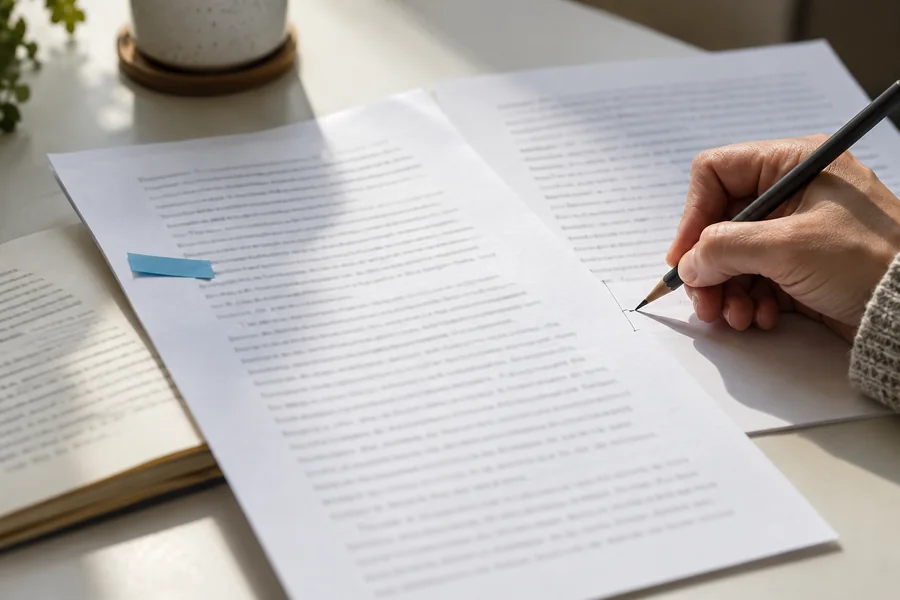
Observe the difficulty, choose the scale of the repair and keep an original against which to test the result.
Original illustrative photograph, created for BookDraftLab.Write a factual description before adapting it to a form
Prepare a plain-language account that names the relevant component, use and review. Avoid minimizing phrases such as only a little help when they conceal what happened. Also avoid inflated claims that every output was verified if you merely read it for style. State the checks you actually performed and the work you created personally.
Nora's working account might say that she wrote the chapters and captions, used a tool to suggest organizational questions and review grammar, and considered a generated illustration that was ultimately excluded. If she instead retained the illustration, the account must say so. This factual account is not automatically the exact wording of a required public disclosure or a sufficient registration description.
Adapt the facts to the destination's current questions, requested detail and placement. Platform reporting, communication with an editor and a note to readers are different communications. Answer each where required; do not assume one message silently satisfies the others. Keep a copy of what you submitted alongside the policy version or checked date.
Recheck when the edition or destination changes
A new cover, translation or revised edition can change the relevant facts. Reusing an old disclosure without reviewing the new files can produce an inaccurate account even if the original was correct. Add new entries when the work changes and distinguish editions in your log. This is particularly useful when different versions use different illustrations or captions.
Policies can change too. Before a submission, republication or registration step, reopen the relevant official sources and note the date you checked them. This guide's 26 October 2026 review date gives you a starting point, not a promise that the linked instructions will remain unchanged. Read the live requirements rather than relying on a screenshot of an old discussion.
Close the process with a small checklist: files match the record; actual uses are described accurately; current destination questions have been answered; unresolved issues have a named next step. The checklist does not certify the work. It helps you approach the decision with evidence, clear boundaries and fewer gaps in your own account.
A component entry tied to a particular edition.
PROJECT: Seasonal Color · working edition 02
COMPONENT: cover candidate C
ORIGIN: image service, identified in the project’s use log
WORKING FILE: candidate-c.png
HUMAN CHANGES: composition and color edits retained in candidate-c-edited.png
EXPORTED EDITION: candidate not included; current cover is a separate file
REVIEW PERFORMED: compared the candidate with the written brief and inspected visible text
OPEN WORK: record the intended destination and check its current instructions before preparing the relevant answers

Do not describe the discarded candidate as part of the exported cover.
BOOKDRAFTLAB / ORIGINAL TEACHING MATERIAL
An original illustrative specimen. Adapt the method to your own material.
Prepare an edition-specific AI use packet
- List the components in the edition: main text, captions, cover, interior images and any translation. Mark the source and current status of each.
- Create log entries for relevant AI uses, including discarded candidates where useful to explain the process. Identify retained output and your actual review.
- Choose the intended destination and read its current official requirements. Record the page URL, checked date, applicable category and any unresolved question.
- Compare the final exported files with the log. Ask collaborators for missing information and preserve uncertainty rather than guessing.
- Write a factual account, adapt it to required communications and retain the submitted wording. Schedule a fresh check when the edition or destination changes.
A component inventory, a use log, a destination-policy note and the factual account used to prepare the relevant submission answers.
Can you trace the submission account to actual components and saved versions, cite the destination policy you checked, and identify any requirement that still needs clarification?
Make your own version here.
Common questions
If I heavily edit generated text, is it assisted content?
Do not assume so. KDP's guidance, as checked on 26 October 2026, keeps content created by an AI tool within its generated definition even after substantial editing. Other destinations may use different terms or ask different questions. Preserve the origin and editing history, then apply the actual current instructions rather than selecting the label that feels most favorable.
Does disclosing AI use make the content safe to publish?
Disclosure answers a transparency or reporting requirement; it does not establish accuracy, originality, rights or suitability. Review those issues separately using the actual material and relevant terms. If a material rights or registration question remains unresolved, consult the appropriate official guidance and qualified advice. A complete log helps explain the work but cannot settle every substantive question.
Do I need the same statement everywhere?
Usually the useful starting point is the same factual record, but the required communication can differ. A platform form, publisher inquiry and copyright application may ask different things and use different definitions. Check each applicable destination. Keep copies of answers and note which edition they describe so a later change does not silently make the old account inaccurate.
Sources and further reading
- Amazon KDP Content Guidelines: AI content section; checked 26 October 2026
- US Copyright Office: AI registration guidance, effective 16 March 2023; checked 26 October 2026
- US Copyright Office: Part 2, Copyrightability, published 29 January 2025; checked 26 October 2026
- Wiley: AI guidelines for book authors; checked 26 October 2026
These sources support further investigation. Check requirements at the relevant publisher or platform before a submission.