


Preserve the draft and choose a question to investigate during a diagnostic read. Collect locations and examples before deciding on a small set of structural priorities. Test the central change in a bounded passage, trace its consequences through the manuscript, and revise the affected scenes or sections. Move to sentence work once their jobs are stable. Finish each pass by checking the result against a specific stopping condition.
Useful when a complete draft needs work but an undifferentiated list of problems makes every page seem equally urgent.A finished draft creates a new problem: there is now enough material to distract you from the book as a whole. A weak transition is easy to see. An ending that depends on a choice the protagonist never makes can hide behind several beautifully written chapters. If you revise only what catches your eye, you may polish passages that the next structural change removes.
Use a sequence that moves from the book’s central effect to the work of individual scenes and finally to sentences. Our invented manuscript follows Nessa, a ceramic conservator restoring a gallery mural damaged during an earlier job. The draft’s ending feels unearned because a convenient discovery excuses her silence. We will diagnose that problem, test an alternative and trace the consequences before changing every page.
Preserve the draft and define the revision question
Save a clearly labeled copy before making substantial changes. Give the working revision one master file and keep removed material somewhere separate. This lets you experiment without treating every deletion as permanent loss. A recoverable version also makes it possible to compare whether the new scene actually solves the problem you identified.
Write the book’s intended central effect in plain language. For Nessa’s story: readers should follow someone who confuses competence with never admitting a mistake, then watch her choose accountability over a flawless reputation. This statement is a working editorial aim. It does not have to summarize every subplot or sound like a publisher’s description.
Now ask one whole-book question. “Does Nessa’s own behavior lead to the ending?” is useful. “Is the novel good?” is too large to answer with a revision action. Keep secondary concerns nearby, but resist making each of them the current task. The first pass needs a clear reason for opening the manuscript.
Read for evidence before proposing repairs
Read in stretches large enough to experience the story’s movement. Note where your attention changes and what the text gives you at that point. Separate observation from diagnosis. “The gallery director announces the solution before Nessa speaks” is evidence. “Nessa is passive” is an interpretation that should be supported by several moments.
Use brief margin labels so reading does not become immediate rewriting. You might mark unclear motive, repeated information, missing consequence or strong scene. Record what is already working as carefully as the weaknesses. Nessa’s argument with her apprentice may contain the relationship the revision should protect, even if the plot surrounding it needs substantial work.
At the end, group related observations. If Nessa avoids decisions in the opening, lets others discover the damage and receives forgiveness without disclosure, those moments form a pattern. If only one quiet scene lacks movement, it may be a local issue. The distinction determines whether you need a structural revision or a more focused scene repair.
Nessa hands over the report she withheld.
The director postpones the opening.
She shares the complete record with the apprentice.
Choose a small number of high-impact priorities
Turn the evidence into priorities with an expected effect. A useful priority names the problem, the change to test and what should become clearer. “Strengthen the ending” is an aspiration. “Make Nessa disclose her earlier report before the director discovers it, so the resolution follows her choice” gives you an experiment.
Select the change with the widest useful consequences. If a different disclosure scene transforms the final act, it may also reveal what must be prepared earlier. Fixing all repeated words before that test would create little protection against rework. Keep line-level observations in a later-pass list so noticing them does not require acting on them immediately.
A short plan might contain three priorities: restore Nessa’s agency in the final act, prepare the apprentice’s refusal to cover for her and clarify why the gallery deadline creates pressure. These priorities interact. They are not three unrelated makeovers. Decide which one to test first and name the result you will look for before expanding the revision.

Inspect the draft for evidence before turning every mark into a commitment to rewrite.
Original editorial illustrationTest the central change in a bounded passage
Choose the smallest passage that can demonstrate whether the proposed repair works. You do not need to rewrite the first half before testing a different final confrontation. Draft the altered scene using temporary notes for missing setup, then read it for the question that prompted the revision.
In Nessa’s original ending, an old letter proves that another worker caused the damage. The director forgives her and the mural opens on time. That resolves the external difficulty while avoiding the promised personal change. In the new version, Nessa brings her own incomplete report to the preview and states what she omitted. The director stops the opening and asks for an independent assessment.
The revised scene should not automatically reward the disclosure. Accountability becomes more credible when the cost remains. Test whether Nessa’s choice now changes the outcome and whether the ending can still offer movement rather than simple punishment. You are checking the story’s logic, not adding a moral speech to tell readers what to think.
A former employee sends a note that explains the crack. The director tells Nessa it was never her fault. She decides to trust people more.
Before the preview begins, Nessa gives the director the report she withheld. He postpones the opening. When the apprentice offers to help document the mural, Nessa gives her the complete record and asks what should happen next.
The altered sequence links disclosure, consequence and a changed way of working. It does not solve technical conservation questions by assertion. Those details require their own research and review in the manuscript.
Test the repair before rewriting every dependent page.
An invented novel reveals a hidden letter in chapter twelve, but the protagonist has already acted on its information in chapter nine. The issue is causal order, so start with the dependency.
A structural revision experiment
- Observation
The decision relies on information not yet available.
- One test
Move the discovery before the decision.
- Inspect afterward
Motivation, suspense and the later discovery scene’s job.
Save the original and rewrite a small connected sequence. Moving the discovery may clarify motivation while weakening suspense, so compare both effects before applying the change across the book. You might instead preserve the original order and give the decision another supported reason. Keep the test’s result with the revision note; a rejected repair can clarify the real problem and prevent you from attempting the same unhelpful change again.
What if the repair creates three more problems?
Trace which problems are unavoidable consequences and which come from the particular solution. Compare a second bounded option before expanding the rewrite. The number of pages changed is not a measure of success; the relevant question is whether the book’s intended movement becomes clearer and more convincing.
Trace the change backward and forward
A successful local test creates dependencies elsewhere. List what the revised scene requires the reader to know, what a character must have done and what later material becomes impossible. This is the step that turns an appealing alternative into a coherent book revision.
Nessa must possess the omitted report earlier. Readers need to understand why she withheld it without being asked to approve. The apprentice needs an established reason to distrust partial records, and the postponed opening must affect something concrete. None of these needs requires a long explanatory chapter. A well-placed exchange, missing attachment or practical disagreement can prepare the final choice.
Also identify what to remove. If the former employee’s letter exists only to excuse Nessa, the revised ending may no longer need that subplot. Saving it because you already wrote several polished pages would keep the old solution competing with the new one. Move the material to your cut file and check whether any useful relationship or fact should be preserved in a different form.
Revise scenes for a changed situation
Once the broad sequence works, examine individual scenes. Name the immediate aim, the resistance and the difference at the end. A quiet scene can pass this test through a change in knowledge or relationship. A dramatic scene can fail it if everyone leaves with the same options and understanding they had on arrival.
The apprentice’s studio conversation originally repeats that the opening is important. In revision, she asks to see the full condition record before continuing work. Nessa gives her an incomplete folder. The apprentice notices the missing sequence and refuses the next task. The deadline now tightens because of an interaction, while the final disclosure gains necessary preparation.
Check transitions after altering scene outcomes. If the apprentice has stopped working, she cannot appear in the next chapter cheerfully completing the assignment without explanation. Revision often leaves these seams. Track the state of the project, relationships and information from one scene into the next instead of assuming the old connecting paragraphs still apply.
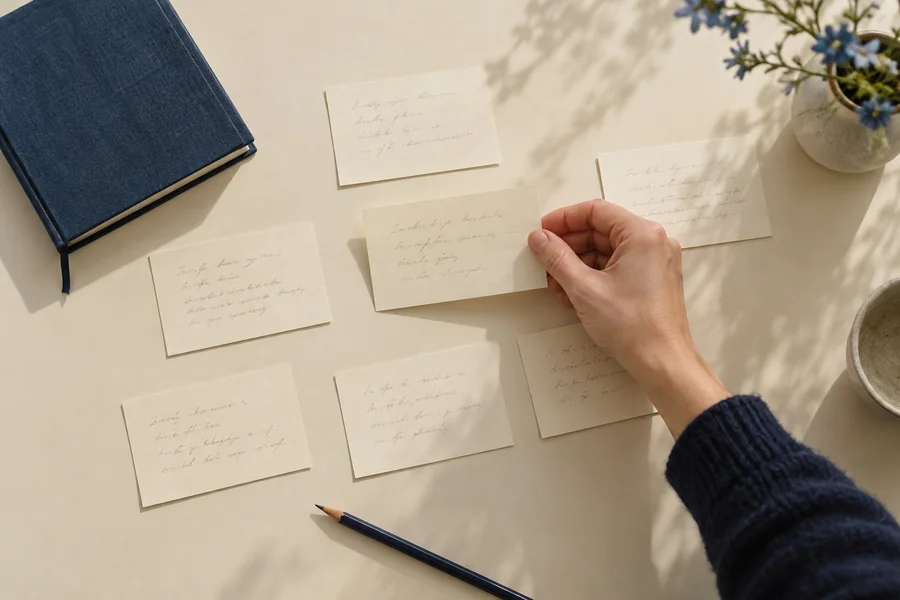
Treat the plan as a working arrangement. Let a passage test it before giving every chapter a permanent place.
Original illustrative photograph, created for BookDraftLab.Move to language when the passage has a stable job
When a scene’s place and purpose are sufficiently stable, revise how it reads. Check viewpoint, physical orientation, sentence emphasis and the balance of action, thought and explanation. Read aloud when useful, especially around dialogue or a sentence whose meaning keeps slipping. You are now improving the delivery of a scene you expect to keep.
Look for language that announces what the revised action already shows. If Nessa hands over the full report and accepts the consequences, a paragraph explaining that honesty matters may reduce the moment’s force. You might instead show which question she finally permits the apprentice to ask. Let the action carry the insight when it can.
Keep consistency and factual checks distinct from stylistic preference. The mural’s location, the report date and who has seen it must agree across the manuscript. Conservation procedures need appropriate verification. A more elegant sentence does not resolve a factual contradiction, just as a correct date does not make a scene emotionally convincing. Separate passes help you see both.
Retest the book and set a stopping condition
After the planned changes, return to the whole-book question. Does Nessa’s behavior now lead to the ending? Read the revised sequence without your notes and inspect the evidence. Do not judge success only by whether the new version feels fresher after spending time with the old one.
Look for newly introduced problems as well as repaired ones. Perhaps the disclosure now happens so late that Nessa’s earlier silence becomes implausible. Perhaps the apprentice has become a device for teaching her a lesson rather than a person with her own work. Those are specific findings for another revision decision. They do not mean the experiment failed completely.
Set the next stopping condition in terms of completed questions: the causal sequence holds, scene outcomes connect, continuity is checked and the intended reader can follow the central change. You may then seek outside feedback or move to a careful language pass. Revision ends through a considered assessment of the current draft, not because no possible alternative sentence remains.
Put the changed practice into an action.
BOOKDRAFTLAB / ORIGINAL TEACHING MATERIALNessa set the report beside the director’s unopened speech.
“I should have given you this before the preview.”
He read the first page standing up. Then he asked the apprentice to take the opening notice off the door.
“I can help with the record,” the apprentice said.
Nessa had already pulled the folder toward herself. She stopped and turned it so they could both read.
“This is everything I have,” she said. “Tell me what is missing.”
An original illustrative specimen. Adapt the method to your own material.
Run a one-problem revision experiment
- Preserve the existing draft. Write one central revision question and collect three textual observations that make the question worth asking.
- Describe a proposed change and its intended effect. Choose a passage small enough to revise without first rebuilding the entire manuscript.
- Draft the alternative, keeping the original available. Read both versions against the question rather than choosing whichever contains the newest phrasing.
- If the alternative helps, list its dependencies: earlier preparation, later consequences and old material that no longer belongs. Put those changes in a practical order.
- Complete the connected changes, then reread the sequence for new seams. Record what is resolved, what remains uncertain and which kind of attention the next pass requires.
A tested revision decision with an evidence trail: the original problem, an alternative passage, its dependencies and a short assessment of the result. Use that record to guide the next pass.
Can you show the original problem, explain how the tested revision addresses it, and name the dependent changes and stopping condition for the next pass?
Make your own version here.
Common questions
Should I revise the whole manuscript from page one?
Begin with a whole-book diagnosis, then choose the passage that best tests the most important change. A page-one rewrite can be appropriate, but it should follow a reason. Otherwise you may repeatedly improve the opening while the structural difficulty that affects it remains unresolved.
How do I cut a passage I still like?
Save it in a separate file with a note explaining why it left the current draft. Then ask what job the passage performs and whether that job still belongs in the revised book. You can value the writing without requiring this manuscript to contain it.
What if my revision makes the draft worse?
Compare the new version with the preserved one using the question you intended to solve. Keep useful discoveries even if you restore the earlier passage. A bounded experiment limits disruption and can reveal that the diagnosis was incomplete, the proposed repair was wrong or another change must come first.
Sources and further reading
These sources support further investigation. Check requirements at the relevant publisher or platform before a submission.