


Define a finished first draft as a complete version you can inspect, with the essential scenes, reasoning, and ending present. Map missing units, choose a provisional ending or conclusion, and draft the consequences needed to support it. Mark minor details with visible placeholders and keep earlier repair ideas in a change log. Finish with a completion pass and a saved version, then hand the remaining quality questions to revision.
Useful when a nearly finished draft keeps reopening earlier chapters before its essential ending or argument exists.You are close enough to the end to see how much still needs changing. A character’s earlier decision no longer fits. Chapter three needs a different example. The ending feels smaller than the book you imagined. Every route forward seems to require going backward first, and the draft stays almost finished.
Finishing a first draft requires an editorial threshold: what needs to exist before you can examine the book as a whole? This guide follows an invented family novel about siblings deciding what to do with their late father’s closed music shop. The examples show how to complete a workable draft without confusing roughness with missing essential thought.
Define completion in manuscript terms
Write down what a complete first draft means for this project. For a novel, it may mean a readable sequence from opening to ending in which the central conflict reaches a provisional resolution. For practical nonfiction, it may mean each promised chapter has an explanation, supporting material, and an actual attempt at its key example or exercise. The threshold depends on the book.
The music-shop novel’s writer defines completion as all major scenes drafted, a decision about the shop made on the page, and the siblings’ relationship left in a discernible changed state. The prose can be uneven. Some transitions and descriptive details can remain rough. The central decision cannot be replaced by “[They sort everything out].” That would omit the work the ending needs to test.
Avoid a definition so strict that it becomes publication readiness, or so loose that a contents list qualifies as a manuscript. The purpose is to create a version you can assess. Name which imperfections are acceptable now and which missing pieces would prevent you from understanding whether the book’s structure works.
Map the remaining work instead of estimating from fatigue
Feeling exhausted does not tell you how much work remains, just as feeling inspired does not mean the draft is nearly done. Make a list of undrafted scenes or sections and unresolved decisions. Give each item a specific purpose. “More middle” is vague; “Scene in which Lena learns her brother has already promised the upstairs room to someone” identifies an event with consequences.
Separate missing manuscript from later revision. The novel may need four new scenes, an ending, and a change note for earlier chapters. Those are different tasks from polishing all dialogue. Place the revision items in a separate list so they remain visible without crowding the finish plan.
Check the list against the book’s promise. If a central question disappears halfway through, the remaining work includes addressing that question, even if no blank page marks the gap. Conversely, an attractive subplot may not need another scene if it has already served its purpose. Your finish map should represent the book’s needs rather than every idea you have had.
Every major scene.
Lena and her brother make the shop decision.
Marked continuity details and sentence polish.
Choose a provisional ending before perfect certainty
You do not need to know the final published ending to draft an ending. You need a plausible resolution that follows from the version you are writing now. List what must be decided, what remains uncertain, and which earlier pressures should converge. Then choose an outcome to test in actual prose.
In the example novel, Lena wants to reopen the shop as it was; her brother wants to leave town. A provisional ending could have them close the retail business while keeping one room for a different shared purpose. That outcome is not automatically satisfying. Drafting will test whether the characters have earned it and whether it resolves the central emotional conflict.
An ending can remain open while still completing movement. The siblings need not solve their whole relationship, but something about their choices must become clear. For nonfiction, you may end with a refined answer, a practical synthesis, or an honestly framed unresolved question. Avoid treating uncertainty as a reason to withhold every conclusion the book has prepared readers to reach.

Keep essential missing work separate from the focused revision passes that follow a complete draft.
Original editorial illustrationDraft the consequences that connect the ending to the book
Once you choose a provisional ending, work backward only far enough to identify the necessary decisions and consequences. What does a character need to discover? What action makes the final choice costly? In nonfiction, what reasoning or evidence must be present before the concluding claim can hold? These questions reveal the remaining structural work.
The siblings cannot suddenly agree because the writer needs the book to end. The draft may need a scene in which reopening becomes possible but demands a compromise Lena cannot accept. Her later choice then responds to something concrete. Write the pressure, the decision, and its immediate consequence rather than using a summary that claims everyone has changed.
Keep the chain short enough to draft. You may identify three scenes rather than designing an elaborate final act. If a necessary setup belongs earlier, note it and decide whether a brief change now is enough to proceed. The goal is to make the ending testable, while preserving a record of the earlier work revision will need.
Distinguish a missing ending from unfinished polish.
A draft with a beautifully written first half and “[ENDING HERE]” is missing essential movement. A complete rough ending with marked details gives you a whole sequence to inspect.
A draft-completion gate
- Resolve in this draft
The siblings decide what happens to the workshop.
- Mark for a later pass
Check the date on the lease mentioned in chapter 6.
- Save at handoff
A complete version plus a separate repair list.
Write through the decision and its immediate consequence even if the language remains rough. Then read across the major movement: does the ending follow from actions the draft actually contains? A placeholder is useful for a detail that can wait; it cannot stand in for the event on which the book’s ending depends. Give the handoff version a name and retain the notes so revision starts from a known set of pages.
What if a late scene changes an earlier assumption?
Record the dependent repair and make only the correction needed to continue coherently. Finish the new movement, then inspect the change across the whole draft. If you repair every earlier sentence immediately, a necessary discovery can pull you back into endless opening-chapter revision.
Use placeholders for details, not for the heart of the book
Placeholders can protect momentum when the missing item is specific and does not determine the structure. You might mark the name of a street to verify, a minor transition to develop, or a source location to complete. Write what is missing and why it matters. Searchable, consistent markers are easier to review than scattered vague notes.
But a placeholder for the central confrontation avoids the very material you need to discover. “[They argue about the shop]” cannot show whether the conflict is credible or whether a decision changes anything. Draft an imperfect argument. It can be awkward and incomplete, but it should contain actual positions, pressure, and a provisional result.
For nonfiction, “[Insert proof]” beneath the main claim may signal that you are not yet ready to call the draft complete. Investigate the claim or revise it to match what you can support. A first draft can contain tracked gaps, but important factual uncertainty should stay visible and should not be presented publicly as established knowledge.
Contain backward revision with a change log
As you approach the end, you may discover changes needed earlier. Keep a log with the proposed change, affected location, and reason. This prevents the insight from disappearing and lets you continue using the revised assumption. The log is especially helpful when a new ending changes a relationship or argument across several chapters.
The novel’s writer decides that the brother has wanted to leave from the beginning. They record three earlier scenes where this needs setup, then draft the ending under that assumption. If an earlier contradiction makes the next scene impossible to understand, they make the smallest necessary repair now. Other setup can wait for the whole-draft review.
Do not use the log to postpone every hard choice. It records decisions and known repairs; it is not a substitute for deciding what happens next. Review it periodically so that two entries do not quietly contradict each other. When a major new idea would change the entire book, assess that idea deliberately rather than letting it spread through the manuscript one casual note at a time.
Break the finish plan into complete units
Turn the remaining-work map into sessions with observable outcomes. A unit might be a scene, a section, or the first half of a difficult exchange. Avoid units based only on vague effort, such as “make the ending better.” A clear task helps you begin and tells you when to stop or what remains.
For the music-shop novel, the next unit is: “Draft Lena accepting a meeting with the proposed buyer, while deciding what she will not agree to.” The following unit shows that boundary being tested. This is more useful than demanding the entire last chapter in one sitting. Each unit gives the writer new information about the ending.
Use a schedule that fits actual capacity, and leave room for tasks that take longer than expected. A numerical target can help with rough drafting, but it should support the unit’s purpose. Adding words after a scene has done its job will not make the finish line closer in an editorial sense.
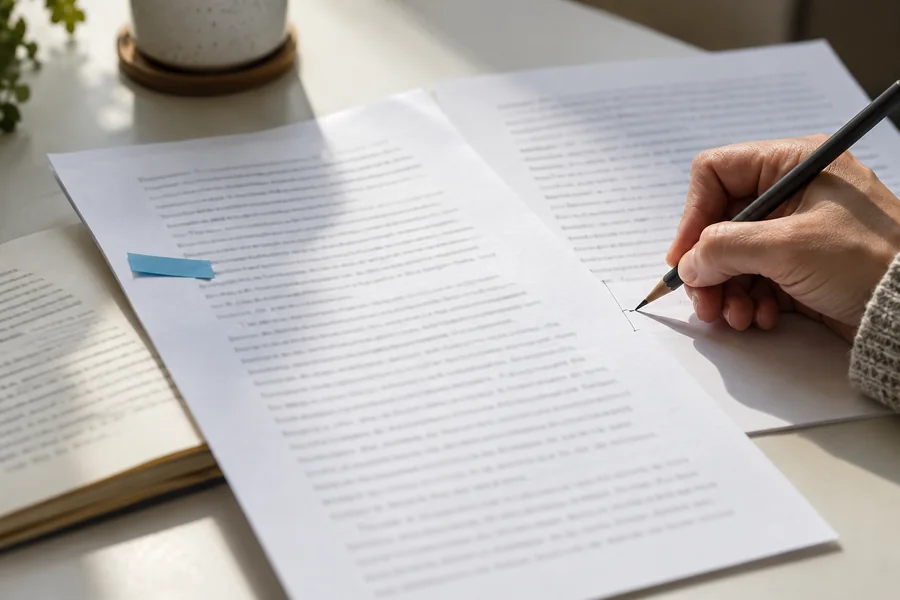
Observe the difficulty, choose the scale of the repair and keep an original against which to test the result.
Original illustrative photograph, created for BookDraftLab.Perform a completion pass before a quality overhaul
After drafting the ending, make a pass focused on whether the promised manuscript exists. Find missing scenes, empty sections, unresolved central placeholders, and contradictory working assumptions. Fill or clearly classify those gaps. This pass asks whether the book can be examined as a whole, rather than trying to make every page equally polished.
The writer discovers a scene heading with no scene and a note that the brother reveals an important promise. They draft a rough version because the reveal changes the ending. They also find a repeated description and several flat lines of dialogue. Those enter the revision list. Sorting the tasks keeps completion from expanding into endless refinement.
The boundary is practical rather than absolute: writing and revision often overlap. You can fix a sentence while reading, but keep returning to the pass’s purpose. If you spend the entire session adjusting chapter one, you have left the completion task. Mark your place and return to the gaps that prevent a full-draft assessment.
Make a clean handoff to revision
When the completion conditions are met, save a clearly named version and write a short draft report. Record what the book currently does, the biggest unresolved concerns, known placeholders, and the change log. This gives your future self a useful starting point and preserves the milestone without pretending the manuscript is finished for readers.
If circumstances allow, take some distance before the structural read. The appropriate interval depends on your schedule and project. When you return, begin by examining the whole book’s movement, rather than assuming the first paragraph needs attention first. Educational resources on revision distinguish larger structural work from later sentence-level work; use that distinction to choose a purposeful next pass.
Finishing a first draft does not guarantee publication or establish the book’s quality. It produces something specific: a complete enough version to read, question, and revise with evidence. Let the milestone mean that. You can acknowledge the work completed and still make a rigorous plan for the book it has not yet become.
The draft is done when I like the ending and have fixed all the weak chapters.
This first draft is complete when all major scenes exist, Lena and her brother make the shop decision on the page, and the final scene shows the immediate effect on their relationship. Minor continuity details can remain marked. Earlier setup changes go in the revision log unless they block the ending now.
The revised standard asks for essential story work and makes the remaining revision visible. It does not require certainty about every sentence before a whole-draft review.
A completion agreement with the missing work named.
THIS DRAFT IS COMPLETE WHEN
Lena and her brother make the shop decision in a written scene, and the final scene shows their immediate response to it.

STILL MISSING
Their answer after the offer changes. The current note says only that they agree.

MAY REMAIN MARKED
The date on the earlier invoice and two setup changes needed before a later revision.

NEXT UNIT
Draft the answer, then write the first action each sibling takes. Read the ending once before reopening chapter one.
BOOKDRAFTLAB / ORIGINAL TEACHING MATERIAL
An original illustrative specimen. Adapt the method to your own material.
Create a first-draft completion agreement
- Write three to five conditions that describe a complete first draft for your book. Include the central question or conflict and what must happen on the page.
- Map the missing scenes or sections. Separate essential drafting from later structural and sentence-level revision.
- Choose one provisional ending or conclusion and list the decisions, evidence, or consequences needed to make it plausible. Turn the next item into a small drafting task.
- Draft that unit, update the change log, and schedule the next completion unit. When all conditions are met, save a named draft and write a short handoff note for revision.
A completion agreement, a remaining-work map, one drafted unit, and a revision log that keeps later work visible without erasing the finish line.
Can someone follow the book's central movement through an ending or conclusion, with essential gaps filled and remaining repairs recorded separately from the completed draft?
Make your own version here.
Common questions
Is it acceptable if my first draft is much shorter than planned?
Yes, if the essential manuscript exists and the shortness reflects compression you can examine. Check whether important scenes, explanations, or reasoning are absent. A shorter complete draft gives you useful information; a skeleton that skips the central work may need more drafting before a whole-book review.
Should I revise the beginning before writing the ending?
Revise enough to resolve contradictions that block the ending, and record other changes for later. Some writers need more backward revision than others. The practical test is whether the revision enables the next work or repeatedly delays the same unresolved ending.
What if I discover the book needs a different ending?
Test the new ending and identify its consequences for earlier material. You can finish a coherent version under a new working assumption, then revise the setup. If the change replaces the book’s central premise, pause to assess the larger redesign rather than calling every new direction a minor repair.
Sources and further reading
- Further reading: Portland State University on the writing process
- Further reading: UW–Madison on revising longer projects
These sources support further investigation. Check requirements at the relevant publisher or platform before a submission.