


Start a scene with someone attempting a specific action in a particular place. Give the obstacle a reason to resist, add only the context needed to understand the attempt, and draft the responses until a choice changes the situation. Let physical details affect what people can do. Afterward, state what changed and leave a small revision list, so polishing one encounter does not replace writing the next part of the draft.
Useful when a scene idea stays at the level of summary and you need an entry into rough action.A scene can look enormous when all you have is a note saying that two people argue at a railway station. You still have to decide who arrives, what they want, what they say, where they stand and why this encounter deserves space in the book. Trying to solve every detail before writing often produces a longer note instead of a scene.
Start with a small card that gives you enough direction to attempt the prose. In this workshop, an apprentice clock repairer named Iona wants to borrow a station's maintenance key from her former supervisor, Malik. She believes a stopped platform clock contains a message from her missing brother. Malik is preparing to lock the office. The example is invented for this exercise; its purpose is to make drafting decisions visible.
Choose a piece of action you can actually stage
A chapter might contain several scenes, a passage of summary or both. For now, choose a stretch of action in which a reader can remain oriented: a particular encounter, attempt or discovery. You do not need a fixed number of pages. You need a situation with enough pressure to make someone act. A conversation counts when its requests, refusals or revelations affect what can happen.
The station note becomes manageable when you specify the encounter: Iona reaches the maintenance office five minutes before Malik leaves. She has not spoken to him since quitting her apprenticeship. That gives the writer a door, an approaching departure and an uncomfortable relationship to work with. It also gives the scene somewhere to start. The story of her entire apprenticeship can wait.
Ask what you would be able to see or hear if you stood nearby. If the answer is only that Iona feels anxious about her brother, find an action that puts that anxiety under pressure. Her hand stopping Malik's door from closing is draftable. An abstract account of her emotions can become context once something is happening.
Write the want as an immediate attempt
The character's life goal and scene goal are related but different scales of decision. Iona wants to find her brother across the book. During this encounter, she wants Malik to lend her the maintenance key before he leaves. The smaller goal tells you what action she might take in the next paragraph. It also lets you recognize an answer that changes her position.
Write a want that could meet resistance. To feel understood is important emotionally, but it does not yet tell you what the character requests or risks. Iona may want Malik to recognize that she was right to leave. She nevertheless has to decide whether to apologize, explain her suspicion, bargain or steal the key. Those are different approaches to the same immediate problem.
Put a provisional sentence on the card: Iona wants Malik to give her access to the clock tonight. Provisional matters. Drafting may reveal that she wants something else more strongly. The card is a starting decision you can revise, not an agreement forbidding discovery.
Iona asks for ten minutes with the key.
Malik keeps the key inside his coat.
She reveals that the request concerns her brother.
Give the obstacle its own reason to exist
Resistance feels thin when it appears only because a writer needs an argument. Malik has a reasonable responsibility: the maintenance key opens equipment spaces, and he remains accountable for it. He also believes Iona once walked away from work that other people had to complete. His refusal can come from practical concern and hurt without turning him into a villain.
Obstacles can be physical, social, informational or internal. The office is closing; Iona lacks proof; telling the truth might expose her brother's previous interference with station equipment. You do not need all of these at maximum intensity. Select the obstacle that creates a meaningful choice. If every possible inconvenience arrives together, you may spend the scene arranging problems rather than following a person.
Write the resistance from the other side: Malik will not hand over an unrestricted key to someone who refuses to explain her purpose. This gives him an understandable position. It also suggests an opening for change. He might accompany her, ask for evidence or offer a safer form of access.

The invented letter and doorway offer a situation. A scene follows the attempt until the available choices change.
Original editorial illustrationAdd only the context the attempt needs
A first draft needs enough context for action to mean something. It rarely needs the complete history of everyone involved before the encounter begins. Choose the information that changes how a reader interprets this request. Iona knows Malik keeps the key on a blue cord. Malik knows she abandoned the apprenticeship. Neither needs to explain the station's full maintenance structure in dialogue.
Place a contextual detail beside an action. Iona sees the blue cord disappear inside Malik's coat and recognizes that asking politely will not be enough. When he calls her apprentice out of habit, she corrects him, then realizes she has made the request harder. History enters through present friction. You can leave a placeholder for the exact date she quit if it is not necessary to draft this moment.
Distinguish a research gap from an invented fact you are treating as settled. A note such as [CHECK HOW THIS CLOCK IS ACCESSED] keeps uncertainty visible. Later research may alter the physical action. There is no benefit in polishing elaborate machinery that the story cannot actually use.
Check the space as carefully as the dialogue.
In a second invented scene, Bea wants a parcel from a locked shop. The clerk is outside holding the shutter key. A quick blocking study prevents an emotionally clear exchange from becoming physically impossible.
A scene’s physical route
- At the start
Bea and the clerk stand outside the closed shutter.
- The attempt
Bea offers the collection slip; the clerk reads the name.
- The change
The clerk unlocks the side entrance, but keeps the slip.
The retained slip supplies a consequence: Bea gains access while losing control of a document. Draft the exchange with those positions in mind. If a later line puts the clerk behind the counter, include the movement that got them there or deliberately cut ahead. The sketch belongs in your working notes; the prose needs only the transitions and objects that affect what the reader understands.
What if the scene is all conversation?
Track what each speaker is trying to obtain, prevent or understand. Add a physical action when it changes access, pressure or meaning. You do not need a gesture after every line, but a reader should be able to tell where the conversation occurs and what its outcome changes.
Draft attempts and responses instead of a report
Begin with the first action that puts the want into play. Then let each response affect the next attempt. Iona asks for the key. Malik asks why. She says she wants to inspect her old repair. He points out that the clock has been stopped for months. Her convenient explanation has failed, so she must reveal something or change tactics.
This sequence gives you a useful drafting question: because that happened, what does this person do now? You are not obliged to create a dramatic reversal after every line. Small changes count. A refusal makes a character choose a different appeal; a detail makes a listener reconsider; a silence leaves someone exposed. Follow what each person can reasonably know and notice.
If you catch yourself writing that they argued for a while, decide whether the argument is the important action or merely a bridge. If it matters, choose one request and response to dramatize. If it does not, summarize it honestly and move to the moment when their situation changes.
Iona asked for the key, but Malik was angry about the apprenticeship. They argued until she mentioned her brother.
Malik drew the blue cord inside his coat. Iona kept her hand against the office door. 'Ten minutes,' she said. 'You can stand beside me.' He looked at her hand. 'You left three clocks on my bench.' She took her hand away. 'This one's about my brother.'
The draft stages a request, a boundary and a new piece of information. It still leaves room to change the language later.
Let physical details participate
A few selected details can keep an exchange from floating in an empty room. Choose details that affect attention or action. Malik's coat means departure is imminent. The door means Iona can physically delay him, although doing so risks antagonizing him. The stopped clock is visible through the window, making her request concrete. You do not need an inventory of the office.
Track movement simply enough that a reader can follow it. If Malik steps into the corridor, Iona cannot still be blocking him inside without an intervening action. A rough sketch can help when a scene contains several entrances or objects. The sketch is for your understanding; the reader needs only the positions that matter.
Use sensation through the viewpoint character's attention. Iona may notice a ticking desk clock because the platform clock's silence bothers her. Another character might notice the cold corridor instead. Selected perception can carry feeling without requiring a paragraph that names every emotion or decorates every surface.
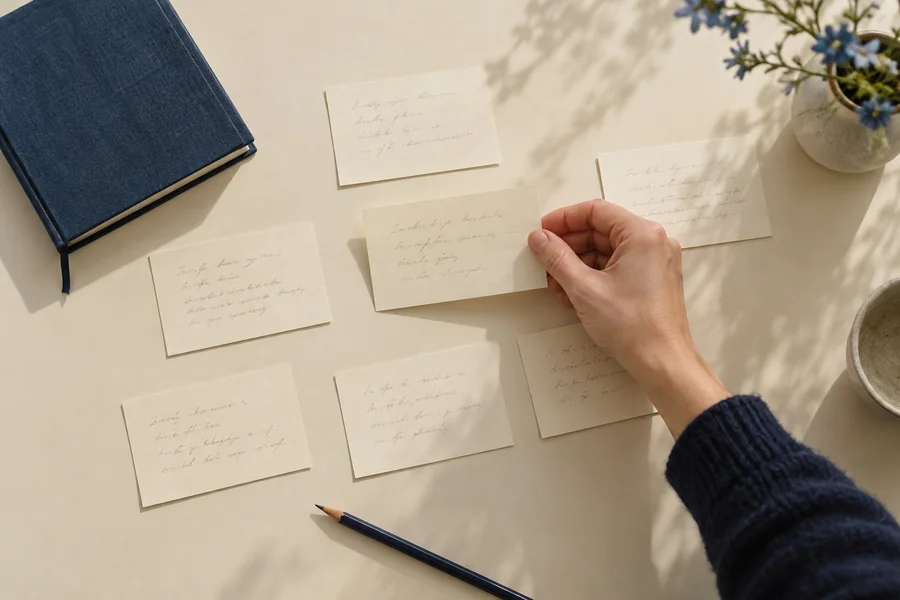
Treat the plan as a working arrangement. Let a passage test it before giving every chapter a permanent place.
Original illustrative photograph, created for BookDraftLab.Discover the consequence before polishing
A scene earns a place when something about the continuing situation changes. The outcome need not be a catastrophe or a cliffhanger. Malik might refuse the key but agree to open the clock himself in the morning. Iona gains access, loses secrecy and faces a delay. That is a more particular result than either a simple yes or a complete defeat.
Compare the situation before and after in plain language. Before: Iona has a suspicion and no access. After: she has conditional access and has told someone about her brother. The next scene now has a different starting point. If you cannot name any consequence, check whether you stopped too early, summarized past the choice or chose an encounter that does not need full dramatic treatment.
Do not force every scene into the same success-or-failure shape. A quiet recognition can matter. The useful requirement is relevance to this book: what does the reader understand, expect or worry about differently because this stretch of writing happened?
Make a light revision note and continue
Read the draft once for orientation, motive and consequence. Can you identify who wants what, why the response makes sense and what remains unresolved? Fix a missing action that prevents comprehension. Record larger questions separately so that reviewing one scene does not become an indefinite rewrite of the entire manuscript.
For Iona's scene, a useful note might say: establish why Malik takes the brother claim seriously; check access procedure; reduce repeated apologies. These are actionable. A note saying make it more compelling gives you no next move. Mark the most important uncertainty first, because beautiful sentences cannot repair a scene whose central permission is unearned.
Then write a return sentence: tomorrow, Iona arrives expecting Malik and finds another maintenance worker waiting. This is an invitation to the next session, not an obligation to keep that exact development. You have produced rough material, learned something about the relationship and created a specific question for the next piece of writing.
Make the disclosure change the next answer.
BOOKDRAFTLAB / ORIGINAL TEACHING MATERIALMalik brought the key out of his coat, but kept the cord around his wrist.
“What does your brother need with that clock?”
Iona took her hand off the door. “He thinks it stopped before the accident.”
“The clock was here.”
“So you said.”
He set the key on the bench between them. She could reach it now. Taking it would be easier than explaining why she no longer believed him.
“Tell me when you brought it in,” she said.
An original illustrative specimen. Adapt the method to your own material.
Make one card, then write the attempt
- Choose an encounter with two people and one immediate request. Write the place and approximate time at the top of a page.
- Complete three sentences: the viewpoint character wants; the strongest obstacle is; the other person has reason to resist because. Keep each sentence concrete.
- List three details that could affect action. Choose one piece of history the reader needs now and leave other background outside the scene.
- Draft until someone makes a choice that changes the available options. Use visible placeholders for research gaps instead of inventing certainty.
- Write a before-and-after statement and three revision notes. Choose one small correction, make it, and leave a starting sentence for your next session.
A scene card, a rough scene, a two-sentence account of its consequence and a short revision list. Keep the card beside the draft so you can compare what you planned with what the characters actually did.
Can you identify the immediate attempt, explain the resistance, and point to a choice that leaves the situation different from how the scene began?
Make your own version here.
Common questions
Does every scene need conflict?
Every scene benefits from a reason to be present, but conflict can be quiet. Someone may be trying to understand a discovery, decide whether to trust a friend or accept an offer they wanted earlier. Look for an active question and a consequence. Do not add an argument simply to satisfy a rule when uncertainty, choice or changing understanding already carries the moment.
How long should my first scene be?
Write enough to stage the meaningful attempt and its result. A fixed word target can help you sit down, but it cannot tell you whether a scene is complete. If the encounter keeps expanding, identify the central choice and remove detours from the drafting plan. Later, read it alongside neighboring scenes to judge proportion and pace.
Can I draft dialogue first and add action later?
Yes, if you keep enough notes to remember who is present, what changes and how the exchange ends. A dialogue-only pass can reveal the request and resistance. During revision, add actions that alter meaning or orient the reader. Avoid inserting a gesture after every line merely to break up speech; some lines can stand together naturally.
Sources and further reading
- Purdue OWL: Fiction basics — further reading on plot and character
- OpenLearn: Start writing fiction — introductory course
These sources support further investigation. Check requirements at the relevant publisher or platform before a submission.