


How to Choose a Book Idea
Build a three-idea comparison sheet, save one sample for each, and select a project with a defined trial boundary.
Read the guide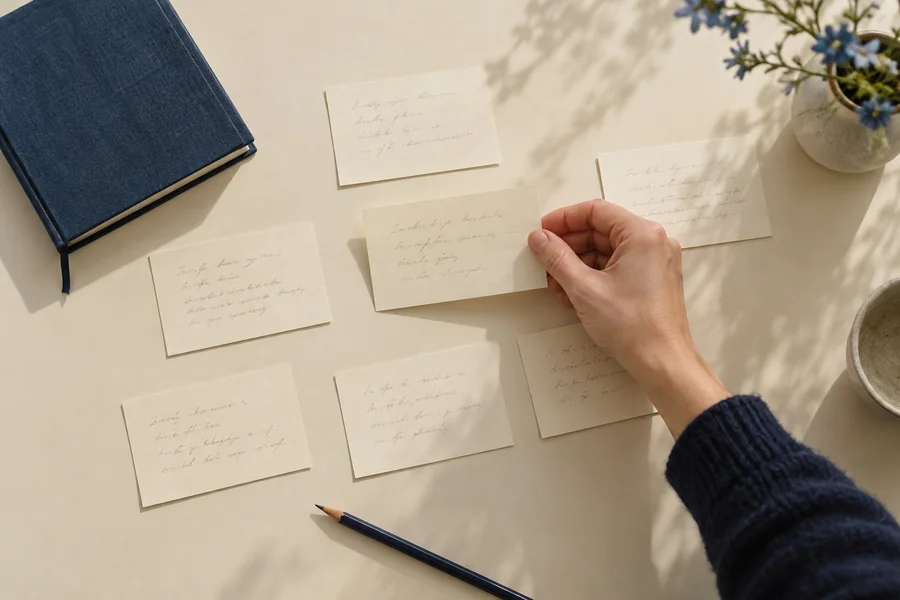
A book can begin with a question, an image, a subject you know well, or a situation you cannot stop thinking about. None of these has to arrive with a title, a genre, and twenty chapter headings attached. The useful first task is to discover what the idea asks you to make. Give yourself enough of a direction to try a sample, then let the sample answer a question the plan could not.
This collection separates four jobs that are easily bundled together: beginning a project, choosing among ideas, understanding an intended reader, and keeping useful material. Start with the job that is actually unclear. If you already have several promising projects, another list of prompts may not help. If you have a clear subject but no reader, a detailed chapter plan may only organize the wrong material more neatly.
Find the right lessonChoose the first unresolved decision. You can leave with a small piece of work rather than a complete theory of the book.
Compare two short writing tests, then choose a bounded experiment.
YOU’LL MAKE An idea decisionName what the reader knows and the experience the book invites.
YOU’LL MAKE A reader hypothesisWrite a provisional promise and one passage that tests it.
YOU’LL MAKE A first-page testIf a sample changes the promise, record what you learned. A plan can become more precise through writing; you do not have to settle every chapter before beginning.
A book about an old neighborhood greenhouse.
A volunteer must decide whether to reopen the greenhouse before a missing donation is accounted for.
The place still matters. The decision gives the writer a person to follow, an immediate pressure and a passage to test.
Your turn: Write the first request somebody makes in that situation. Stop after the answer changes what can happen next.

Choose a reader, a promise and one passage that will test the idea.
Original editorial illustrationAn original illustrative specimen. Adapt the method to your own material.
Build a three-idea comparison sheet, save one sample for each, and select a project with a defined trial boundary.
Read the guideWrite a one-page reader brief and annotate a scene with three decisions the brief helps you make.
Read the guideSave one contextualized observation, develop three fictional possibilities, and draft a short scene linked back to the note.
Read the guideCreate a beginning packet containing a book promise, one complete test passage, two connected next steps, and a return note.
Read the guide
A clear task and a specific return note can give the next available session a useful beginning.
Original illustrative photograph, created for BookDraftLab.Describe a possible book in ordinary language and write a sample that belongs in it. For fiction, that might be an exchange in which somebody wants something difficult. For nonfiction, it might be a short explanation with a concrete example. Notice what was enjoyable to explore, what required research, and which assumptions changed while you wrote. Keep the evidence from that test beside the project brief. You are choosing a direction to investigate, not signing away the right to revise it.
A notebook can hold observations without turning every fragment into an obligation. Separate material for this book from ideas for later books, research questions, and sentences you simply want to remember. Add enough context to understand a note when you find it again. “Thursday visitor asks about a missing delivery” is a more usable fragment than “great twist.” A modest retrieval habit can matter more than an elaborate tagging system that becomes another unfinished project.
Before drafting, finish the sentence “This sample will help me decide…” You might be testing whether a situation creates enough interest, whether you enjoy explaining the subject, or whether the intended reader needs background you have not included. This gives a rough sample a useful purpose. It also prevents a common misunderstanding: assuming an unfinished passage has failed because it cannot yet perform every job of a finished book.
After writing, answer the question from the material rather than from the hours invested. If the scene produced a more interesting supporting character, note that possibility. If the nonfiction explanation depended on three unresearched claims, name them. Choose a next task that follows from what happened. Sometimes that is another scene; sometimes it is narrowing the book or reading a relevant source.
Keep enough of the experiment to see why you made the choice. Beginning becomes a sequence of informed attempts rather than waiting for the right level of certainty.