


Choose a bounded period, relationship, or question rather than beginning with your whole life. Inventory moments and distinguish direct memory, information from others, and details supported by records. Check what can be checked, preserve uncertainty where evidence ends, and draft from the knowledge you had at the time. Add present reflection separately so readers can follow how your understanding changed without being asked to accept invented dialogue or another person's private thoughts.
Useful when you want to shape lived experience into a book without smoothing uncertain memories into asserted facts.You do not need to fit your entire life into the first chapter of a memoir. A smaller period, relationship or recurring question often gives you a more workable beginning. The difficulty is choosing what belongs while respecting the difference between a vivid memory and a fact you can support. A smooth story is not a good reason to invent the missing link.
For this workshop, imagine a writer remembering the final summer of her family's laundrette. She returned to help close it and assumed the work would be practical: count machines, sort receipts, return keys. Instead, she began to question what keeping the business had cost her mother. This hypothetical project will help us examine scope, scenes, research and reflection without claiming that the example describes a real family.
Choose a bounded period and a live question
An autobiography commonly takes a broad view of a life; a memoir can focus on a particular experience and the understanding that develops around it. You do not need to settle every category before writing. You do need a useful boundary. The laundrette project covers the summer of closure, with earlier memories included when they change how the writer understands that summer.
Give the project a question rather than a moral you have already decided to prove. What did my mother think she was preserving? leaves room for discovery. My mother wasted her life establishes a verdict before the writing begins. Your initial interpretation may change as you look at records, speak to people and notice contradictions in your own account.
Write a working scope sentence: this memoir follows twelve weeks of closing the laundrette to explore how our family confused being needed with staying together. The exact number of weeks is part of the hypothetical plan, not a rule. The sentence tells you why a childhood scene might belong and why an unrelated university anecdote probably does not.
Make a memory inventory before an outline
Collect moments without forcing them into a complete narrative. A row of blue chairs, the first day a machine was removed, an argument beside the change counter, a customer bringing a cake: each can become a short entry. Record what you remember directly and what you only remember being told. Those are different starting materials, even when both matter emotionally.
Add a confidence note. You may clearly remember carrying a cracked plastic basket but be uncertain whether the conversation happened on the same day. Keep those details separate rather than joining them because they make an elegant scene. A dated photograph could confirm the basket or the room; it may not confirm who said what beside it.
A useful inventory includes moment, approximate time, people present, sensory fragments, possible relevance and unresolved questions. You are not grading the worth of your experiences. You are making material retrievable. A small, ordinary memory can become central once you understand the question it helps explore.
The pale square where the machine stood.
The mother’s exact words.
What the practical question may have meant.
Research what can be checked
Personal writing can use records without becoming a report about records. In the laundrette project, a lease, repair invoice or calendar entry could clarify the sequence of closure. A photograph might establish the room's arrangement. An old message could show what the writer believed at the time. Record where each item came from and what it actually supports.
Do not ask a document to prove more than it contains. A repair bill establishes a service and a date; it does not establish why the mother chose to keep the business open. A smiling photograph does not settle whether someone was content. Separate the recorded fact from your interpretation, especially when the interpretation drives a difficult claim about another person.
Keep a research log alongside the manuscript: source, location or date, relevant detail, permission question if applicable and remaining uncertainty. When a detail cannot be verified, you can leave it uncertain, omit it or describe the limits of your recollection. You do not have to replace every gap with a confident sentence.

Keep remembered details, corroborating material and later interpretation distinguishable while drafting.
Original editorial illustrationInterview for perspective, not a forced agreement
Other people may remember the same summer differently. Explain what you are writing and ask whether they are willing to talk. Start with open questions about concrete experiences: what do you remember about removing the machines? What did you think would happen after the closure? A question that assumes your conclusion can make the conversation less useful.
Make clear notes about who said what and when. Ask before recording, and distinguish a person's recollection from an independently confirmed fact. If an aunt remembers the argument on a different day, record the discrepancy. The disagreement may expose how memory organizes experience; it is not automatically evidence that one person is dishonest.
Someone's willingness to speak does not answer every question about quotation, publication or sensitive material. Agree on expectations where you can, preserve your notes and seek qualified advice when the project raises material privacy, contractual or legal concerns. This guide offers a writing process, not permission to publish everything you learn about another person's life.
Mark the difference between memory and reconstruction.
Suppose you remember finding a packed suitcase in a hallway but cannot remember the conversation that followed. A memoir draft can retain the force of that image without supplying dialogue as fact.
A memory boundary record
- Remembered
The suitcase blocked the bottom stair.
- To examine
A dated photograph; a diary entry; another person’s account.
- Not established
The exact sentence spoken beside the case.
Draft the image from the perspective you can support. If reflection belongs in the passage, distinguish what you understood then from what you think now. Records may adjust the date or complicate your recollection; they do not necessarily recover every word. Preserve those distinctions in working notes so a later polished version does not turn a convenient reconstruction into an apparently certain scene.
What if another person remembers it differently?
Record both accounts with their sources. Decide what the passage can honestly claim, and consider whether the difference itself matters to the book. Do not silently combine two accounts into one seamless memory simply because the composite scene reads more smoothly.
Draft a scene within the limits of your knowledge
Choose a moment that changes the writer's understanding or behavior. The removal of the first machine may work better than a summary of the business's history. What did the writer attempt, notice and misunderstand? Let the physical action carry part of the scene. The empty square on the floor can matter because the writer had never seen it before.
Dialogue needs particular care. If you do not remember exact wording, do not claim to have a transcript. You can summarize the conversation, mark remembered fragments as remembered or explain your approach to reconstruction. Avoid fabricating a devastating speech simply because it would make the scene clearer. Clarity can come from describing what you understood and what you could not understand.
Stay within your perspective when describing other minds. The mother looked away is observable; the mother realized she had wasted thirty years is a private conclusion unless supported and attributed. A memoir can examine the writer's interpretation of that gesture while acknowledging that it remains an interpretation.
Mum stared at the empty space and understood that she had sacrificed everything for us. 'You were my only reason,' she said.
I remember her looking at the pale square where the machine had stood. I cannot recover her exact words. What stayed with me was her question about whether the floor underneath the others would look the same. At the time, I heard a practical concern. Years later, I wondered what else she was trying to measure.
The revised passage belongs to our hypothetical writer. It distinguishes remembered action, uncertain wording and later interpretation without claiming access to the mother's private thoughts.
Put the remembering self in conversation with the past self
A memoir has the person who experienced events and the person trying to understand them now. Their perspectives do not have to agree. The writer may once have believed that closing the laundrette meant liberation, then discover that she also lost a place where she knew how to be useful. Let that tension remain specific rather than turning every scene into a lesson.
Reflection can be brief. After describing the writer counting returned keys, a present-day sentence might question why she counted them twice. The reflective passage earns its place when it changes our understanding of the action. An explanation that repeats the scene's obvious emotion may flatten it instead.
Watch for retrospective certainty. Knowing the outcome can make earlier decisions appear inevitable or foolish. Ask what the younger self genuinely knew and what alternatives seemed available then. Giving that self a fair account often produces more complexity than writing from a position of permanent superiority. The same generosity can extend to other people without excusing every action.
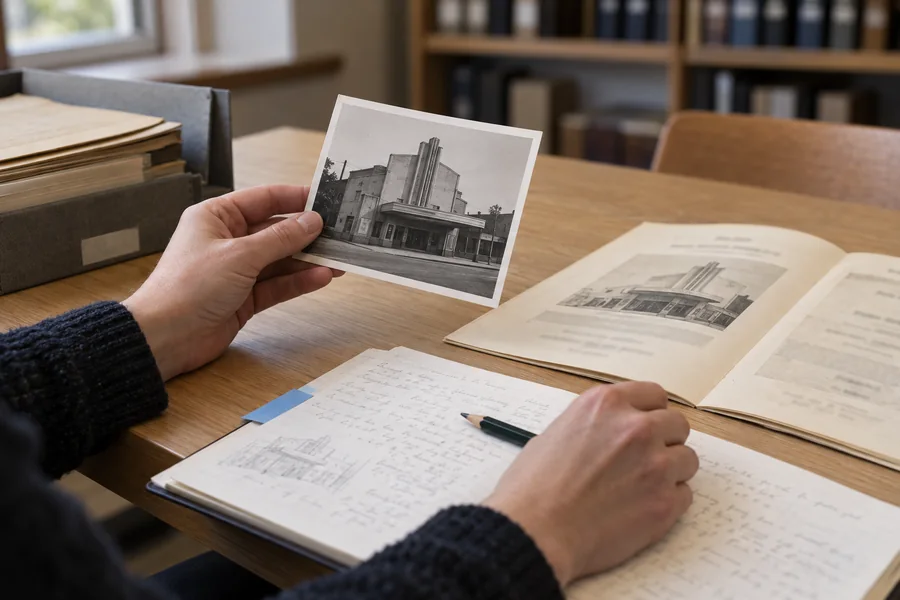
Give the source a location you can recover. Keep what it establishes separate from what still needs checking.
Original illustrative photograph, created for BookDraftLab.Arrange material around a developing understanding
Chronology is a useful starting point, but a list of everything that happened may not answer your central question. Put each candidate scene on a card and write its function: establishes an expectation, complicates a belief, reveals a contradiction or shows a choice. If three scenes perform the same job, choose the strongest or explain why the repetition matters.
The laundrette memoir could move from preparation, through physical dismantling, to the first week after closure. Earlier memories would enter where they alter those stages. An argument about the last repair invoice might make room for a childhood memory of helping with the accounts. The connection needs to be more than the presence of the same object.
Keep a separate factual timeline even if the narrative uses a different order. Mark every departure from chronology so you can track whether the reader has enough orientation. Moving a scene in the manuscript does not change when it happened. Combining different events into one apparent event creates a different issue and should not happen invisibly for convenience.
Review claims, exposure and unresolved uncertainty
Before polishing, identify statements about real people that carry substantial consequences. Ask what supports each claim, whether it is necessary to the memoir's question and how clearly you distinguish fact from inference. A name change alone does not settle the issues raised by identifiable people, private documents or serious allegations. Get appropriate advice when those concerns become material.
Also review your own position. Where have you made yourself unusually perceptive, innocent or consistent? What complicating evidence did you leave out? A candid memoir does not require self-punishment, but it benefits from examining the narrator's preferred version of events. Keep contradictions that help the reader understand the experience rather than smoothing them into a flattering arc.
Finish this pass with an uncertainty list. Each item can be checked, qualified, omitted or left openly unresolved. The final manuscript may still contain uncertainty because the experience itself remains partly unknowable. Honest limits can be part of the meaning, especially when the book concerns a relationship you can no longer ask someone to explain.
Let the later voice acknowledge its distance.
BOOKDRAFTLAB / ORIGINAL TEACHING MATERIALThere was a pale rectangle where the machine had stood. I remember my mother looking at it, then at the other machines. I cannot recover her exact question, only that she wanted to know whether the floor beneath them would look the same.
I heard a question about cleaning. That is the answer I gave her.
Years later, I began to hear another possible question in it. I do not know whether she intended that meaning. I know it belongs to the way I understand the room now.
An original illustrative specimen. Adapt the method to your own material.
Build a memoir evidence packet
- Choose a bounded period or relationship and write a question you want to explore. Avoid beginning with a verdict about what another person really felt.
- List six moments. For each, separate direct memory, information someone told you and details supported by records.
- Choose one moment and identify two checkable details. Search your own available material and record what the evidence does and does not establish.
- Draft the moment from your position at the time. Add a short reflection from your present perspective without inventing another person's private thoughts.
- Mark uncertain dates, reconstructed wording and sensitive claims. Decide the next action for each before treating the passage as finished.
A scope sentence, a memory inventory, a source log and one scene with clearly marked uncertainties and a distinct reflective passage.
Can you mark which details come from memory, records, or later interpretation, and keep the scene intelligible without inventing a missing exchange or private motive?
Make your own version here.
Common questions
Do I need an extraordinary life to write a memoir?
A particular way of examining an experience can matter more than the apparent scale of the events. Start with a question that remains alive for you and material you can render specifically. An ordinary workplace, a family responsibility or a change in routine may contain enough tension for sustained exploration. Do not inflate events to make them seem more worthy.
What if I cannot remember exact dialogue?
Use summary, remembered fragments or an explicitly explained reconstruction approach rather than pretending to possess a transcript. Preserve any contemporary notes or recordings you do have. The right treatment depends on the project and destination, but uncertainty about wording should remain visible in your process. Inventing a neat speech can change both the event and the impression of the speaker.
Can I leave out events that do not fit the book?
Selection is necessary; a memoir cannot contain everything. Choose by the book's scope and question, while checking that omissions do not create a materially misleading account of events you do include. Keep a factual timeline and a note of important exclusions. If removing context makes your own actions or someone else's appear very different, reconsider the selection.
Sources and further reading
- Purdue OWL: Creative nonfiction overview — further reading on research and reflection
- OpenLearn: The notebook habit — further reading on collecting material
These sources support further investigation. Check requirements at the relevant publisher or platform before a submission.