


Build the routine from a real week and the attention available within it. Choose one manuscript priority, prepare tasks that fit short and longer sessions, and set a modest weekly floor with an optional extension. Leave a specific return note after each session. When work or care interrupts the plan, choose the next usable entry point and adjust recurring problems instead of adding missed sessions to a growing catch-up debt.
Useful when work, care, or variable energy makes an ambitious daily writing schedule difficult to sustain.Your calendar may show an empty hour at nine in the evening, but that does not mean you have an hour of clear attention. Work has overrun, dinner needs making, and you cannot remember why the characters entered the station in the last scene. A plan built entirely from available clock time misses the work of returning to a book.
Writing alongside a job is partly a scheduling problem and partly a task-design problem. This guide follows Nia, an invented museum administrator drafting a mystery novel. Her schedule illustrates choices rather than a recommended workload. The aim is a routine you can adjust to your circumstances without treating sleep, care, and ordinary life as obstacles to defeat.
Audit an ordinary week before promising a new one
Look back at a real week and mark work, travel, care, household tasks, rest, and commitments you value. Then identify possible writing periods and describe their conditions. A quiet Saturday hour is different from twenty minutes on a noisy train. An evening after a difficult shift may suit a small continuity check better than a complex scene.
Nia initially claims five evening hours. Her audit shows that two evenings often involve late work, one is a standing family commitment, and two contain short quiet periods. She also has an occasional weekend block. That is less time than she imagined, but it is more actionable. She can build a plan around two short sessions and one optional longer session.
Do not treat every unallocated minute as a writing debt. Leave space for variable demands and for being a person without a productive task. If the audit reveals almost no capacity, choose a smaller active goal or a temporary holding pattern. A plan that describes current constraints honestly gives you a better starting point than a timetable you can only follow during an unusual week.
Define what this season of the book is for
Choose one main phase for the next period of work: exploring the premise, drafting new material, researching a specific gap, or revising structure. You will still perform smaller tasks from other phases, but one priority helps you decide what belongs in limited sessions. Otherwise, you can spend an entire month maintaining the project without advancing its most important need.
Nia has drafted the opening and knows the mystery’s central discovery, but the middle remains blank. Her current priority is to produce rough scenes that connect the first clue with the midpoint decision. She does not need a cover concept, a polished query, or a new filing system yet. Those might become useful later; they do not solve her present drafting problem.
State the season’s destination in visible manuscript terms. “Work on the book” provides no stopping point. “Draft the three scenes in which the investigator changes her theory” does. Keep the scale small enough that you can review it after a few weeks. You are choosing the next unit of progress, not making an irreversible forecast for the entire manuscript.
Scene 8 and the return note.
The invoice conversation, up to 25 minutes.
The next line or action if interrupted.
Prepare tasks that fit different kinds of time
Create a short menu of tasks with different entry costs. A ten-minute task might be listing the physical actions of a scene or identifying which question a chapter must answer. A twenty-five-minute task might be drafting an exchange. A longer session might develop a complete scene or compare two possible chapter orders.
For Nia, “write chapter eight” is too large for an evening when she has to recover context first. “Draft the conversation in which Amara asks why the store room was unlocked” gives her a place to enter. She keeps the relevant scene summary beside the task. The preparation removes decisions about where to begin without dictating every line she must write.
Match the task to the conditions, including privacy and safety. A commute can support note review if circumstances permit, but it is not automatically an appropriate setting for recorded dictation or sensitive material. Keep personal writing separate from employer systems and obligations. Your routine should use your own available resources without quietly relying on access or time you have not been given.

Leave a passage and a particular task ready for the attention you have available.
Original editorial illustrationGive the week a modest floor and an optional extension
Choose a minimum plan you expect to follow during a reasonably ordinary week. Then identify an extension for weeks with more capacity. This avoids making the most ambitious version your only definition of success. The floor should still involve actual contact with the manuscript, rather than a vague intention to think about it.
Nia’s floor is two twenty-five-minute sessions, each attached to a named scene task. Her extension is a weekend hour that she confirms only after checking the week’s demands. These numbers are illustrations, not a standard. Someone else may prefer one substantial session, several brief sessions, or a rotating plan that follows shift patterns.
Keep the extension genuinely optional. If you quietly count it as essential, you have simply hidden a larger commitment inside the plan. After a few weeks, review what happened. If the floor repeatedly fails, inspect timing, task size, and capacity before raising the target. If it consistently feels too small and you have room, expand one part deliberately rather than filling every gap at once.
Build a session menu for uneven energy.
An available evening does not always come with enough attention for new prose. Prepare different entrances to the same project, so a shorter session can still leave something useful behind.
Three entrances to the manuscript
- More attention
Draft the difficult conversation from the saved return note.
- Less attention
Map the three actions already present in that conversation.
- An interruption
Save the file and write the next unfinished action.
Choose among these tasks when you see the time and attention actually available. Mapping existing action is useful if the scene’s sequence needs inspection; it becomes avoidance if you keep mapping a scene that is ready to draft. At the end of the week, compare the menu with what happened. Keep the entries that helped you begin, and adjust the plan when work, care or rest needs change.
What if every planned session disappears?
Reduce the commitment and reconsider the available window. A five-minute reread with a return note can be a temporary re-entry task, but it should not become a demand to work during needed rest. Replanning is part of fitting the project to your life.
Reduce the work of restarting each session
At the end of a session, leave a brief return note: what you changed, what happens next, and the first action to take. Include the file or scene location if finding it takes effort. The note should preserve orientation without requiring a long diary entry. Two or three specific sentences are often enough.
Nia writes: “Amara has noticed that the invoice lists an extra crate. Next she asks Joel about the delivery. Start with Joel trying to end the conversation because the security guard is approaching.” The next evening, she can enter a live exchange. Compare that with “Continue chapter eight,” which asks her to reconstruct the scene’s purpose before producing a line.
You can also prepare the environment: keep the active document easy to locate, put unrelated notes elsewhere, and decide how to limit interruptions during the chosen period. Do only the setup that solves a real barrier. A long ritual can consume the small session it was meant to protect. The useful measure is whether preparation makes returning easier.
Use missed sessions as information
When a session disappears, record the reason briefly and choose the next available entry point. Do not automatically add the missed work to tomorrow. Catch-up arithmetic can turn a modest routine into a growing debt, especially when the original interruption came from a demanding week rather than a lack of interest.
If Nia misses Tuesday because an exhibition delivery runs late, she keeps Thursday’s original task or reduces it to a smaller scene beat. She does not demand a double session on Wednesday. If three Tuesdays disappear for the same reason, she changes the standing plan. A repeated pattern deserves a scheduling decision; an isolated disruption may need only a restart.
Distinguish an external interruption from an unclear task. If you sit down reliably but spend the session circling the same paragraph, the calendar may be working. You may need to decide what the scene changes, locate a missing source, or permit a rough version. Changing the writing hour will not necessarily resolve a problem inside the manuscript.
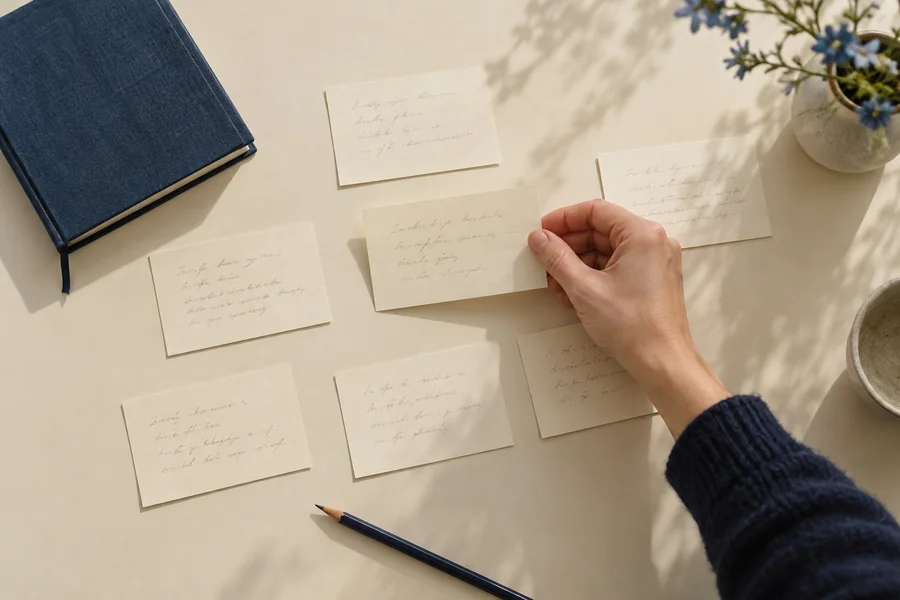
Treat the plan as a working arrangement. Let a passage test it before giving every chapter a permanent place.
Original illustrative photograph, created for BookDraftLab.Review the manuscript before reviewing your discipline
At the end of the week, inspect what changed on the page. Perhaps you drafted a scene, clarified a chapter question, or discovered that an assumed turning point does not work. Record the result and the next useful task. Time spent is relevant, but the review should also tell you what the book now needs.
Nia sees that both evening sessions produced dialogue, yet neither scene moves Amara toward a new decision. Her next task becomes rewriting the scene outcome, not increasing her weekly minutes. In another week, a small outline adjustment may make several future sessions easier. Count that as a concrete result while checking that planning does eventually lead back to prose.
The Illinois Writers Workshop offers guidance on setting manageable goals for a writing routine. Apply that general principle with a manuscript review rather than a verdict about your character. Ask which conditions supported the work, which tasks were too large, and whether the current phase still makes sense. The answers should alter the plan in specific ways.
Plan for demanding periods and a clean return
Jobs have busy seasons, and life brings changes no writing schedule can absorb. Decide what maintaining contact would mean during a known difficult period. It could be one weekly review of the return note, a small scene summary, or a deliberate pause with the project safely stored. Constant low-level guilt is not a useful maintenance strategy.
Before Nia’s exhibition opening week, she saves a current manuscript copy and writes a one-page status note. It identifies the mystery’s working solution, the scene she last drafted, and the next unresolved choice. She sets a realistic point to review the plan after the opening. She does not pretend the week will be an ordinary drafting week.
When you return, begin with orientation and one small piece of work. Avoid making a complete productivity overhaul the price of restarting. A full-time job may make a book’s pace uneven. Your routine is useful when it helps you produce and understand the manuscript across that unevenness, while remaining flexible enough to reflect the rest of your life.
Thursday, 9–10 p.m.: write 1,000 words and catch up on Tuesday.
Thursday, after dinner: spend up to twenty-five minutes drafting the invoice conversation. Open scene 8, read the three-line return note, and write until Joel reveals why he wants Amara to leave. If the evening is interrupted, leave the next line or action in the return note.
The revised plan identifies an entry point and a scene change. It does not assume an hour of attention or turn a missed session into extra debt.
A week recorded as it actually unfolded.
TUESDAY · 18 minutes
Opened scene 8. Drafted Joel’s request that Amara leave. Stopped before her answer.

THURSDAY · 9 minutes
Read the return note. Wrote Amara asking what happens to the unpaid invoice. Marked the connecting action for later.

SATURDAY · 24 minutes
Completed the exchange. Joel’s answer gives Amara a reason to stay.

NEXT WEEK
Keep the short entry routine. Replace the planned catch-up hour with one bounded continuation.
BOOKDRAFTLAB / ORIGINAL TEACHING MATERIAL
An original illustrative specimen. Adapt the method to your own material.
Design a two-week routine experiment
- Review one ordinary week. Mark two or three plausible writing periods and describe their actual conditions, including likely interruptions.
- Choose a current manuscript priority. Prepare three tasks small enough to begin without a separate planning session, plus one optional task for a longer period.
- Set a modest weekly floor and an optional extension. Write a recovery rule that names your next step after a missed session without requiring catch-up.
- Try the plan for two weeks. After each session, leave a return note; at each week’s end, record what changed in the manuscript and revise one part of the plan if needed.
A two-week schedule, a short task menu, a recovery rule, and a review based on manuscript changes rather than an uninterrupted streak.
Does your next ordinary week contain a feasible task and a smaller fallback, with a clear way to return if one planned session disappears?
Make your own version here.
Common questions
Do I have to write every day to finish a book?
No. A repeatable schedule can use daily, weekly, or irregular sessions. The useful question is whether your arrangement produces sustained contact and manuscript progress over time. Choose a rhythm you can return to, and adjust it when work or care demands change.
Should I set a word-count target for short sessions?
Only if it helps the current task. A rough scene may suit a modest word target; a structural decision or source check may not. Pair any number with a clear task so that the target supports useful work rather than encouraging unnecessary words.
What if my job leaves me too tired to draft?
Reassess capacity and the type of task. You might use a different period, a smaller drafting unit, or a temporary maintenance plan. Do not assume that tiredness can always be solved with motivation. A deliberate reduction or pause can preserve a clearer route back to the book.
Sources and further reading
These sources support further investigation. Check requirements at the relevant publisher or platform before a submission.