


Build the outline around the change your reader should make in understanding or action. Turn your material into movable units, choose an organizing logic, and give each chapter a question, contribution, and support requirement. Test the sequence for missing prerequisites and repeated work. Draft a difficult section before polishing the contents list, then revise the architecture using what that writing reveals about evidence, explanation, and the book's actual scope.
Useful when you have nonfiction material but cannot explain why the chapters belong in their current order.You have a notebook full of observations, a folder of research, and twelve possible chapter titles. The trouble begins when you try to put them in order. “Background” seems to belong near the start, but it could fill half the book. Three chapters explain almost the same idea. Your favorite story has no obvious home.
A nonfiction outline becomes easier to use when you treat it as a sequence of reader decisions. What does someone understand, question, or become able to do at each stage? The worked example here is an invented practical book about starting a neighborhood repair café. Its details are planning illustrations, not claims that a particular event or method succeeded.
Write the promise before naming the chapters
Begin with a description of the reader at the moment they pick up the book. “People interested in repair” is a subject audience, but it leaves their situation vague. “A first-time volunteer organizer who wants to hold a small repair event in an existing community space” gives you decisions to serve. They may need help choosing the event’s scope, recruiting appropriate volunteers, and deciding which repairs they cannot offer.
Now describe the book’s useful destination without guaranteeing an outcome. Our example promise is: “Plan a first event with a clear scope, a workable volunteer arrangement, and a way to learn from what happens.” This gives the outline a practical boundary. It does not promise a profitable organization, universal repair expertise, or an event free from problems.
Keep this promise at the top of the outline. If a proposed chapter serves a different reader, either change its function or set it aside. A fascinating history of industrial design may provide context, but it must earn the space it takes from the organizer’s immediate questions.
Empty your material into movable units
Before building a hierarchy, separate your existing material into small units: a question, a claim, an example, a task, or an unresolved issue. “Volunteers” is too large to move intelligently. “What information should an organizer ask a potential volunteer for?” and “Who can decline an unsuitable item?” are usable units. You can see their relationship without pretending they are already chapters.
For the repair-café book, the pile might include choosing a venue, describing the event, creating an intake process, recording unresolved problems, and thanking volunteers. Include awkward material too. Perhaps you have a lively interview about an event that outgrew its room. Label what the story demonstrates rather than merely recording who told it.
Use whatever makes rearrangement easy: individual lines in a document, index cards, or simple notes. Keep source references attached to factual material. Do not spend the session decorating cards or designing a perfect database. The immediate result should be a visible inventory whose parts can change places without losing their meaning.
Who decides when a repair is outside scope?
Explain roles and show a short briefing.
A draft role sheet and questions to confirm.
Choose an organizing logic that suits the promise
A practical book often follows the order in which a reader makes decisions. A history may follow time, an argument may build through competing explanations, and an essay collection may develop by theme or recurring image. None of these structures is automatically more serious. The useful question is which order lets this reader follow the thinking with the fewest unnecessary detours.
Our organizer needs to define the event before recruiting people for it, and needs an intake plan before opening the doors. That suggests a progression from scope to preparation to the event itself to review. A strictly chronological account of how the author first became interested in repair would postpone the reader’s work without necessarily deepening it.
Try two candidate structures on the same material. One could follow the event’s timeline; another could group decisions by people, place, and process. Write a short explanation of what each arrangement makes easier and harder. Choose based on those tradeoffs. You can use a dominant structure while allowing a chapter to depart from it for a clear reason.

Arrange reader questions and supporting material before testing the dependencies in prose.
Original editorial illustrationGive every chapter a question and a change
A chapter title can be attractive while concealing a missing purpose. Add two plain sentences beneath each title: the reader arrives asking this question; the reader leaves with this distinction, decision, or skill. These sentences are for you, so favor specificity over elegance. “The reader understands volunteering” is less useful than “The reader can distinguish an organizing role from a repair role.”
For a chapter called “Choose What Your Event Can Handle,” the arrival question might be: “Should we invite any broken household object?” The departure could be: “We have a short list of item categories to consider, explicit exclusions to verify locally, and a way to communicate the scope before people travel.” The chapter now has a job you can draft toward.
Compare adjacent chapters using the departure sentences. If both end with the same ability, you may have a duplicate. If chapter four requires a decision that chapter seven teaches, move the necessary material forward. This is a stronger sequencing test than asking whether the table of contents sounds balanced.
Check prerequisites between neighboring chapters.
An outline can contain all the right topics in an order that makes the reader work too hard. For a guide to organizing a neighborhood exhibition, compare what each chapter requires and provides.
A reader-dependency map
- Before choosing a room
Know what will be displayed and what access it requires.
- Before inviting lenders
Know the available space and unresolved conditions.
- After the event
Review what the arrangements allowed or prevented.
Move provisional chapter cards before rewriting prose. Explain each move with a dependency: a reader cannot make the room comparison until the display requirements are clear. Some questions will remain iterative, so let an early chapter produce a provisional brief that later work updates. The outline becomes useful when it records those handoffs rather than implying that real projects proceed through perfectly sealed stages.
What if readers enter in the middle?
Give the chapter a short statement of the prior decisions it assumes. Point to the relevant explanation rather than repeating it in full. Test both a continuous read and a single-chapter visit so the book can support navigation without becoming a series of disconnected summaries.
Build a chapter card with enough support to draft
Once a chapter has a job, add its main claim, supporting material, likely objections, and a possible reader activity. For our scope chapter, the claim might be that a smaller, clearly communicated offer gives organizers a more manageable planning problem. The support needs to explain the reasoning and limits; a cheerful anecdote alone cannot establish every practical consequence.
Attach the interview about the crowded room to the specific point it illustrates. Then list missing evidence or reporting: what the venue permits, which responsibilities require local confirmation, and what experienced organizers would question. Distinguish your planning suggestion from a factual requirement. A note saying “verify locally” is useful only when it identifies what needs checking and why.
Do not outline every paragraph unless that detail helps you. A chapter card should reduce uncertainty enough to begin, while leaving room for discovery. If the card becomes longer than a draftable section, write the section. The outline is serving the manuscript when it directs attention toward pages, evidence, and decisions.
Allocate space according to difficulty
Equal chapter lengths can make a plan look tidy and a book feel distorted. Some questions require a brief explanation. Others need definitions, alternative approaches, a worked example, and a discussion of exceptions. Estimate space from the work the reader must do, then treat those estimates as provisional rather than as quotas.
In the example book, arranging a volunteer briefing may need more explanation than choosing a simple event title. If naming receives a long chapter because the author enjoys it, while the briefing gets two pages, the outline has followed the writer’s comfort rather than the reader’s difficulty. Move space toward the decisions with more consequences and more ways to go wrong.
Use a rough total to expose an oversized promise. If every chapter seems to require a miniature book, narrow the audience, the destination, or the number of situations covered. Removing a situation from the promise is often more honest than compressing it until only slogans remain. Keep the cut material in a separate idea list for later use.
Test the outline with a reader journey
Walk through the proposed contents as a specific reader. Imagine Marta, a volunteer with access to a community room but no established repair team. At each chapter, ask what she already knows, what she still cannot decide, and what the next chapter assumes. This is a drafting simulation, not evidence that actual readers will react exactly as you imagine.
Marta reaches a chapter on event communication and discovers that the suggested announcement mentions a booking system. The outline has never discussed whether booking is appropriate. That gap matters. Add the decision before the announcement, or revise the example so it does not quietly depend on an unexplained system. Watch especially for resources the author takes for granted: money, equipment, contacts, time, and authority.
You can also ask a suitable reader to describe the questions they expect the book to answer. Avoid asking only whether the contents “look good.” Specific disagreement is more valuable: “I would need to know what to say when we cannot help someone before I open the doors.” That response gives the outline a concrete revision task.
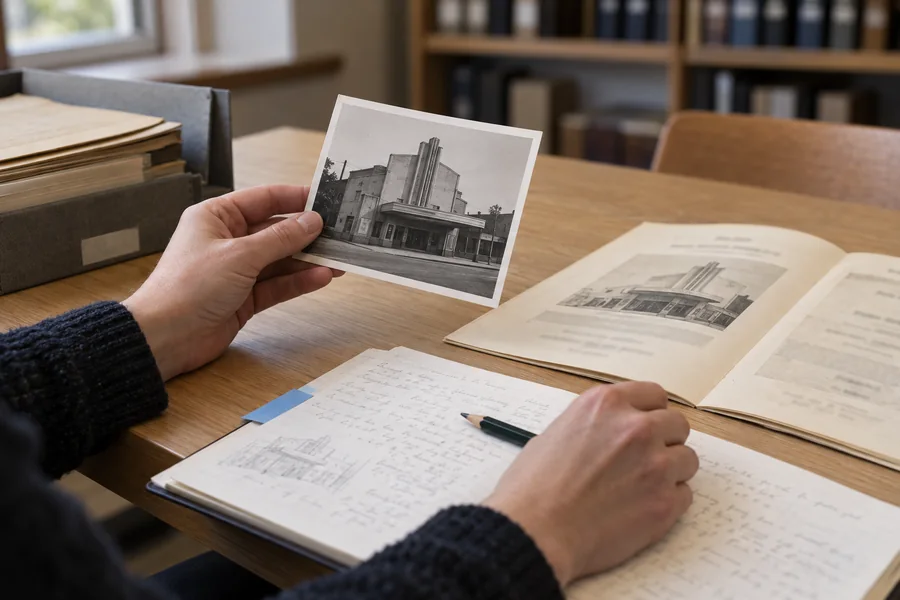
Give the source a location you can recover. Keep what it establishes separate from what still needs checking.
Original illustrative photograph, created for BookDraftLab.Draft a difficult section to check the architecture
An outline can appear convincing because its labels hide the hardest thinking. Choose a central section and write a rough version before expanding the whole plan. In our book, the section about declining an unsuitable item tests the relationships among event scope, volunteer authority, and visitor communication. If those ideas cannot be explained together, the chapter boundaries may need work.
Drafting may reveal that the chapter’s claim is too broad, its example proves something smaller, or an earlier definition is missing. Record the discovery in the outline immediately. Do not force the prose to protect a plan you made before encountering the actual problem. The point of the test is to create information that planning alone could not supply.
Keep the test focused. You do not need a polished opening, finished design, or complete research apparatus to learn whether the structure holds. Stop when you can identify the section’s central reasoning and the major missing pieces. Then make one structural decision and return to drafting, instead of restarting the entire planning process.
Maintain the outline without letting it become the project
Give each chapter a simple status: proposed, draftable, drafted, or needs structural review. Add one next action when something is blocked. “Needs research” is difficult to act on; “Find the venue’s published conditions and note which event activities require clarification” is a task. Keep open questions visible without allowing them to make every chapter seem equally unfinished.
After drafting a chapter, summarize what it actually does and compare that with its intended job. This borrows the general purpose of reverse outlining: inspecting the structure already on the page. If the draft has discovered a better question, update the plan. If it has wandered into another chapter’s territory, decide which chapter should own that material.
Avoid three common traps: using chapter titles as substitutes for reasoning, adding a chapter for every note you hate to cut, and rewriting the outline whenever drafting feels uncomfortable. The finished working outline should make the next useful page easier to identify. When you can name that page and the material it needs, the plan is detailed enough for the next session.
Chapter 5: Volunteers. Discuss finding people, motivation, skills, and teamwork.
Chapter 5: Make the Volunteer Roles Clear. Question: who decides what happens when an item falls outside our scope? Explain organizing and repair roles, show a short briefing, and identify the decisions that need local confirmation. End with a draft role sheet.
The revised card defines the reader’s decision and the material required to support it. It also exposes questions the writer must verify rather than invent.
A chapter card becomes an actual explanation.
BOOKDRAFTLAB / ORIGINAL TEACHING MATERIALBefore recruiting more helpers, decide who can answer a question about the event’s scope. Organizing the room and deciding whether a repair is appropriate are different jobs; do not assume the same volunteer has accepted both.
In our hypothetical briefing, an intake volunteer receives an unfamiliar item. The role sheet identifies whom to ask, while the event’s exclusions remain available beside the intake notes.
Draft those roles before adding names. Mark responsibilities nobody has accepted and procedures still needing local confirmation. The unfinished parts belong on the sheet, where the team can see them.
An original illustrative specimen. Adapt the method to your own material.
Create a seven-card outline test
- Write a reader situation and a restrained, specific promise in two sentences. List three situations the book will not attempt to cover.
- Make seven provisional chapter cards. Give each one an arrival question, a departure ability or understanding, one example, and one unresolved evidence question.
- Arrange the cards in two different orders. For each order, write down the information a reader would need before reaching each chapter.
- Choose an order, merge any duplicate chapter jobs, and draft 300 rough words from the chapter with the hardest dependency. Update the cards using what that drafting reveals.
A one-page book promise, seven working chapter cards, and a short test passage with a note explaining one structural change.
Can you explain what each chapter adds, identify the knowledge required before it begins, and show one passage that tests the outline's hardest structural assumption?
Make your own version here.
Common questions
How detailed should my nonfiction outline be?
Detailed enough to identify each chapter’s purpose, supporting material, and next drafting action. Some writers need paragraph plans; others need a question and a few evidence notes. Add detail where uncertainty blocks drafting. More bullets do not automatically mean the thinking is more complete.
Can I outline after I have already drafted chapters?
Yes. Summarize what each existing chapter actually explains, then compare those summaries with the book’s promise. This reveals repetitions and missing steps. Preserve useful discoveries, but do not assume the current order is correct simply because the chapters already exist.
Does every nonfiction book need exercises?
No. Exercises suit books that ask readers to practice or decide something. Narrative nonfiction may need scenes and interpretation instead. Choose chapter elements according to the reading experience you promised; do not add worksheets merely to make a book appear practical.
Sources and further reading
- Further reading: Purdue OWL on useful outlines
- Further reading: San José State University on reverse outlining
These sources support further investigation. Check requirements at the relevant publisher or platform before a submission.